The ArtSleuth Chronicle
“Curated insights from the world of art.”
Edition of November 20, 2026
On This Day
-
1625
Born
Dutch painter Paulus Potter was baptized; he became renowned for his animal landscapes rendered from a distinctive low vantage point before his early death at twenty-eight.
Wikipedia → -
1907
Died
German Expressionist Paula Modersohn-Becker died; recognized as the first woman to paint nude self-portraits, she produced hundreds of works before her death at age thirty-one.
Wikipedia → -
1911
Born
Photojournalist David Seymour was born; he co-founded Magnum Photos, documented the Spanish Civil War, and captured the plight of young survivors in Children of War.
Wikipedia → -
1978
Died
Italian artist Giorgio de Chirico died; he founded the scuola metafisica movement, which profoundly influenced surrealism with its scenes of arcades, mannequins, and illogical perspective.
Wikipedia →
Artwork of the Day
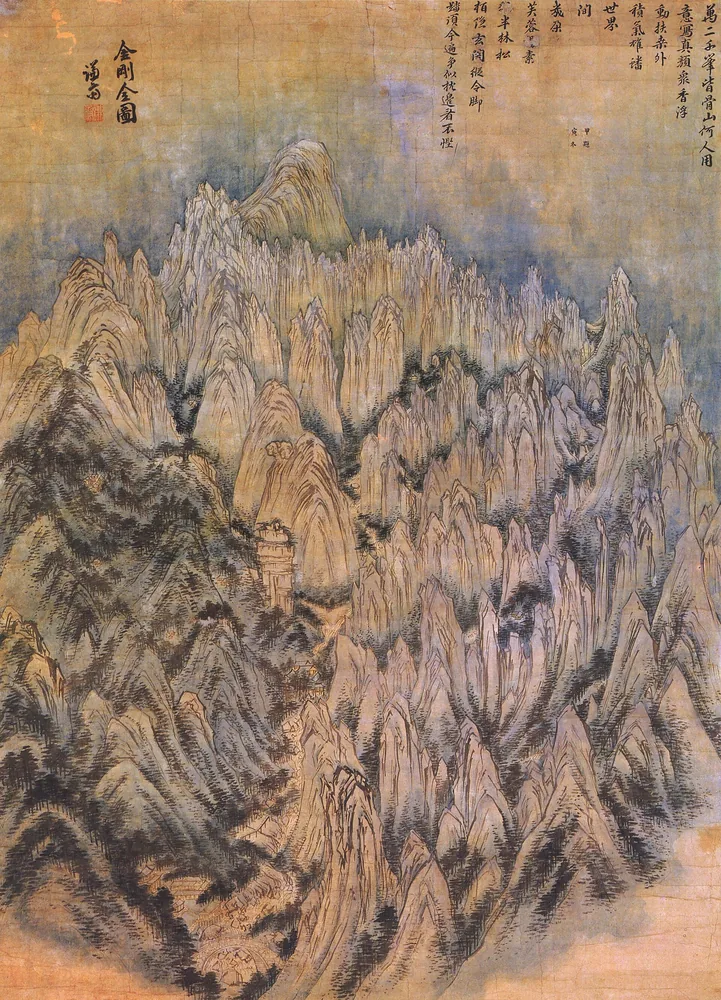
General View of the Diamond Mountains
Painted during the reign of King Yeongjo in 1734, General View of the Diamond Mountains is a celebrated landscape by the Korean artist Jeong Seon. Known natively as Geumgang jeondo, the work's title translates literally to a general view of Mt. Geumgangsan, also known as the Diamond Mountains. Through this panoramic landscape vision, Jeong Seon produced an enduring depiction of the revered Korean mountain range. The work achieved lasting renown and wide acclaim, ultimately being designated as the 217th National Treasure of South Korea on August 6, 1984. Today, this treasured historic landscape is held in the collection of Lee Kun-hee and is carefully preserved and managed by the Ho-Am Art Museum, situated in Yongin within Gyeonggi Province. Its recognition as a registered national treasure underscores its standing as one of the most prominent masterworks of eighteenth-century Korean painting, admired for its expansive view of Mt. Geumgangsan.
Look for
- The panoramic general view of Mt. Geumgangsan, the Diamond Mountains
- The sweeping landscape composition conceived during King Yeongjo's reign
- The delicate Joseon-era landscape brushwork preserved at the Ho-Am Art Museum
The Daily Quiz
5 questions from today's reading. Pick an answer to see if you're right.
-
Which architect designed the Guggenheim Museum Bilbao building alongside the Nervion River?
Answer
Frank Gehry. The museum building in Bilbao was designed by Canadian-American architect Frank Gehry.
-
In the woodcut printmaking technique, how is ink typically applied to the flat surface of the block?
Answer
Rolling over the surface with a brayer. Ink is rolled over the surface using an ink-covered roller known as a brayer.
-
Which notable milestone did Artemisia Gentileschi achieve in Florence during the Italian Baroque period?
Answer
She became the first woman member of the Accademia di Arte del Disegno. Artemisia Gentileschi was the first woman to become a member of the Accademia di Arte del Disegno in Florence.
-
What domestic phenomenon in Japan prompted Katsushika Hokusai to create his famous series Thirty-Six Views of Mount Fuji?
Answer
A domestic travel boom. Hokusai created the series in response to a domestic travel boom in Japan alongside his personal interest in Mount Fuji.
-
Which historical style did the founders of the Pre-Raphaelite Brotherhood seek to emulate in their art?
Answer
Quattrocento Italian art. The Brotherhood sought a return to the abundant detail, intense colours, and complex compositions of Quattrocento Italian art.
Puzzle Corner
Who am I?
- In 1914, I proclaimed that art is higher than reality and must make as little use of reality as possible to approach the spiritual.
- Though I began my career as a figurative painter in the Netherlands, I gradually abandoned realism in search of universal values and aesthetics.
- I became one of the key pioneers of twentieth-century abstract art, distilling my visual vocabulary down to simple geometric elements.
- I simplified my spelling after 1911 and became world-famous for compositions structured around pure geometric forms.
Reveal the answer
Piet Mondrian. Piet Mondrian was a pioneering Dutch abstract painter who distilled visual art into simple geometric elements in search of universal harmony. Wikipedia →
Scrambled masters
RDDAWE PROPEH
American realist painter of Nighthawks known for depicting solitude, light, and shadow in urban and rural settings.
Show answer
Edward Hopper Wikipedia →
ADRVDE CUMNH
Norwegian painter of The Scream who developed a distinctive style of soul painting shaped by illness and bohemian life.
Show answer
Edvard Munch Wikipedia →
AJHNNOES EMERREV
Dutch Golden Age painter from Delft celebrated for meticulously crafted domestic interior scenes of middle-class life.
Show answer
Johannes Vermeer Wikipedia →
Word of the Day
Foreshortening
for-SHOR-tən-ing
A technique in linear perspective where an object's dimensions parallel to the line of sight appear shorter than its dimensions perpendicular to the line of sight. It creates the optical impression that forms recede or project into three-dimensional space.
Example: An object or figure oriented along the viewer's direct line of sight so that its receding length appears dramatically compressed.
Wikipedia →Daily features are written by ArtSleuth's AI (Google Gemini) from the linked Wikipedia articles. Paintings: public domain, via Wikimedia Commons.