The ArtSleuth Chronicle
“Curated insights from the world of art.”
Edition of November 19, 2026
On This Day
-
1665
Died
Nicolas Poussin, master of classical French Baroque whose clear, ordered compositions favored line over color, passed away in Rome.
Wikipedia → -
1770
Born
Danish-Icelandic sculptor Bertel Thorvaldsen, who achieved international acclaim in Rome creating works in a heroic neoclassical style, was born.
Wikipedia → -
1949
Died
Belgian painter and printmaker James Ensor, whose provocative works became a major influence on expressionism and surrealism, died in Ostend.
Wikipedia → -
2001
Died
Canadian painter and stained glass artist Marcelle Ferron, a signatory of the Refus global manifesto and key figure among the Automatistes, died.
Wikipedia →
Artwork of the Day
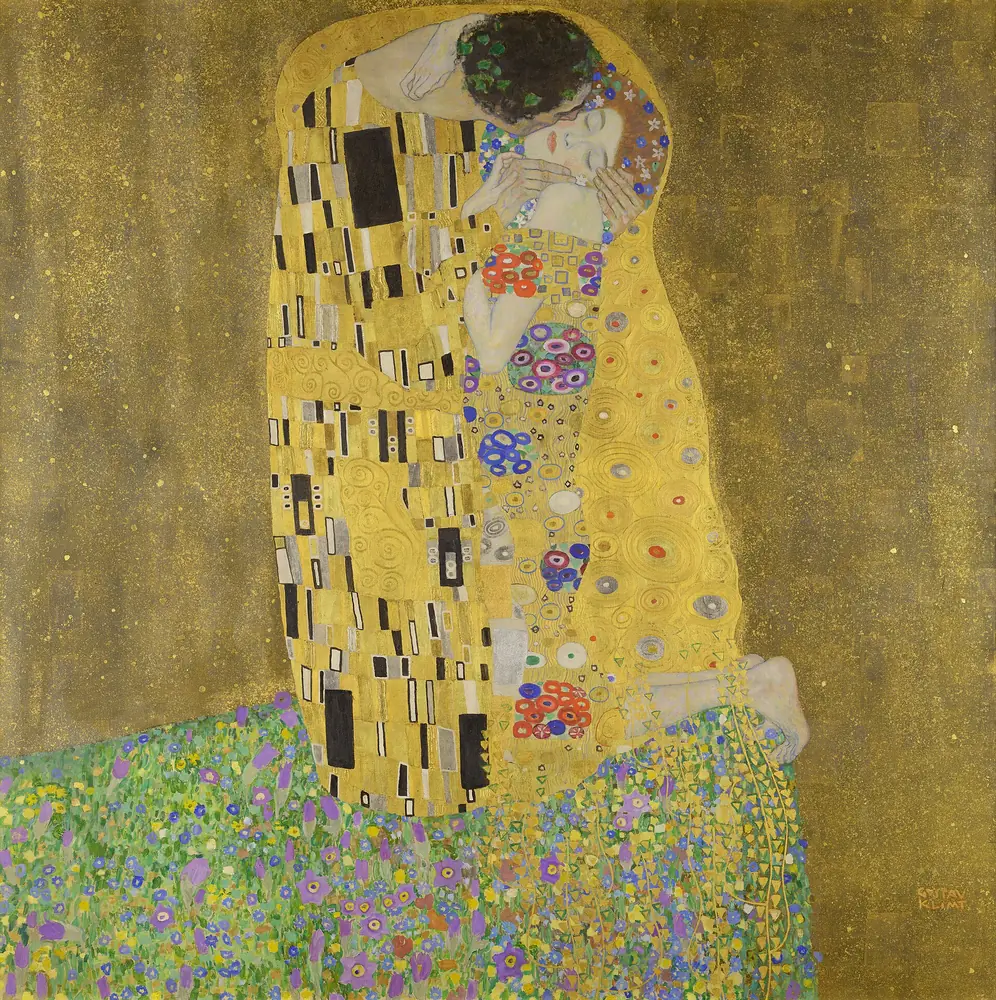
The Kiss
Painted between 1907 and 1908, The Kiss represents the absolute zenith of Gustav Klimt's celebrated Golden Period. First exhibited under the title Liebespaar (the lovers), this oil-on-canvas masterpiece portrays an entwined couple enveloped in lavish robes, kneeling together in an intimate embrace. Klimt enriched the surface using delicate additions of gold leaf, silver, and platinum, drawing profound inspiration from the organic forms of the Arts and Crafts movement as well as contemporary Art Nouveau aesthetic principles. The composition is celebrated as an enduring pinnacle of the Vienna Secession, Austria's distinctive flourishing of the Art Nouveau style. Housed today within the Österreichische Galerie Belvedere in Vienna's Upper Belvedere Palace, the radiant painting remains Klimt's most acclaimed and recognizable achievement.
Look for
- Lavish ornamental robes patterned with gold leaf, silver, and platinum
- The intimate embrace of the two lovers kneeling closely together
- Organic, decorative motifs inspired by the Arts and Crafts movement
The Daily Quiz
5 questions from today's reading. Pick an answer to see if you're right.
-
Which agreement secured the Medici art collections for the city of Florence?
Answer
The Patto di famiglia. Anna Maria Luisa de' Medici negotiated the Patto di famiglia to give the family collections to Florence.
-
Where was Marc Chagall born in 1887?
Answer
Near Vitebsk. Chagall was born into a Jewish family near Vitebsk, located in modern-day Belarus.
-
What common recipe is used to create an encaustic painting medium?
Answer
Beeswax and damar resin. Encaustic recipes most commonly combine beeswax and damar resin alongside added pigments.
-
Who was the architect that founded the Bauhaus school in Weimar?
Answer
Walter Gropius. Architect Walter Gropius founded the Staatliches Bauhaus in Weimar in 1919.
-
Around 1422, which ruler employed Jan van Eyck as painter and valet de chambre?
Answer
John III the Pitiless. Surviving records show Van Eyck served John III the Pitiless, ruler of Holland and Hainaut.
Puzzle Corner
Who am I?
- In 1917, I relocated to a suburb of Nice after developing a rigorous style based on decorative patterns and flattened forms.
- Between 1900 and 1905, my intense use of color led critics to brand me as one of the Fauves, or 'wild beasts.'
- Alongside Pablo Picasso, I am regarded as one of the principal figures who defined revolutionary visual art in the early twentieth century.
- I was a French draftsman, printmaker, and sculptor, celebrated worldwide above all as a painter of radiant color and fluid line.
Reveal the answer
Henri Matisse. You are Henri Matisse, the pioneering French modernist celebrated for his vibrant Fauvist masterpieces. Wikipedia →
Scrambled masters
EGEENU CLIERDOXA
Leader of the French Romantic school whose vibrant work emphasized color and movement over sharp linear precision.
Show answer
Eugène Delacroix Wikipedia →
AOIGAACVGR
Italian master who transformed Baroque painting through tenebrism and intensely realistic physical drama.
Show answer
Caravaggio Wikipedia →
SGEROGE RETSUA
French post-Impressionist who devised chromoluminarism and pointillism with mathematical precision.
Show answer
Georges Seurat Wikipedia →
Word of the Day
Craquelure
krak-LOOR
A fine network of dense cracks appearing across the surface of a material such as oil paint, tempera, or ceramic glaze, caused by drying, aging, shock, or intentional craft.
Example: Chinese Ge ware ceramics are celebrated for intentional crackle patterns across their glazes.
Wikipedia →Daily features are written by ArtSleuth's AI (Google Gemini) from the linked Wikipedia articles. Paintings: public domain, via Wikimedia Commons.