The ArtSleuth Chronicle
“Curated insights from the world of art.”
Edition of November 21, 2026
On This Day
-
1898
Born
Belgian surrealist René Magritte was born, known for placing familiar objects into unexpected contexts to probe reality.
Wikipedia → -
1900
Event
Paintings by Impressionist pioneer Claude Monet were presented in Paris at Gallery Durand-Ruel.
Wikipedia → -
1909
Died
Skagen painter Peder Severin Krøyer died, celebrated for canvases that achieved record prices among Danish works.
Wikipedia → -
2010
Died
American artist and writer Margaret Taylor-Burroughs, co-founder of the DuSable Museum of African American History, died.
Wikipedia →
Artwork of the Day
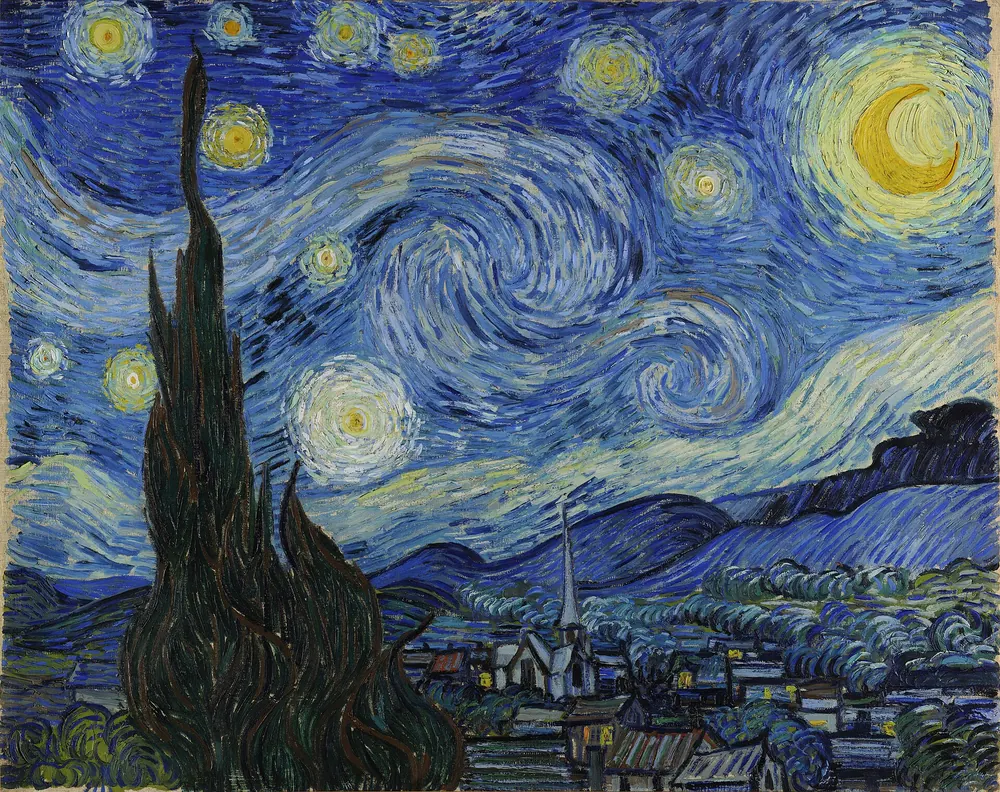
The Starry Night
In June 1889, Dutch Post-Impressionist painter Vincent van Gogh created The Starry Night while staying at the Saint-Paul-de-Mausole mental asylum near Saint-Rémy-de-Provence. Having voluntarily entered the former monastery following a mental breakdown, he looked out from the east-facing window of his bedroom just before sunrise. Rather than producing a strict documentary study, Van Gogh translated that nocturnal vista onto canvas with the addition of an imaginary village nestled beneath the vast, swirling sky. Rendered in rich oil paint, the composition merges careful observation with deep psychological and spiritual intensity. Acquired in 1941 through the Lillie P. Bliss Bequest by the Museum of Modern Art in New York City, the masterpiece has endured as an iconic touchstone of modern Western art.
Look for
- The imaginary village resting below the hills
- The view inspired by an east-facing asylum bedroom window
- The dynamic night sky captured just before sunrise
The Daily Quiz
5 questions from today's reading. Pick an answer to see if you're right.
-
Whose acquisition of paintings in 1764 marked the founding of the Hermitage Museum?
Answer
Empress Catherine the Great. The museum was founded in 1764 when Catherine the Great acquired a collection of paintings from Berlin merchant Johann Ernst Gotzkowsky.
-
Which major twentieth-century art movement did Pablo Picasso co-found?
Answer
Cubism. Pablo Picasso is noted for co-founding the Cubist movement alongside his work developing collage and constructed sculpture.
-
How does woodcut carving differ from wood engraving?
Answer
The block is cut along the wood grain rather than the end-grain. In woodcut printing, the block is carved along the wood grain, whereas wood engraving uses the end-grain.
-
What drawing material did Georges Seurat use on rough paper alongside his pointillist experiments?
Answer
Conté crayon. Georges Seurat used conté crayon for drawings executed on rough-surfaced paper.
-
During which Japanese era was the term Nihonga coined to distinguish traditional painting from Western-style work?
Answer
Meiji period. The term Nihonga was coined during the Meiji period (1868–1912) to separate Japanese-style painting from Western-style Yōga.
Puzzle Corner
Who am I?
- Influenced by a peer's views of Mount Fuji, I pursued landscape prints marked by atmospheric poetry and multiple color impressions.
- Departing from traditional courtesan and actor portraits, I gained acclaim for horizontal vistas along the Tōkaidō route.
- I later published a celebrated vertical series depicting one hundred famous locations across Edo.
- I am remembered as the last great master of the Japanese ukiyo-e woodblock print tradition.
Reveal the answer
Hiroshige. Utagawa Hiroshige was the preeminent Edo-period printmaker famed for 'The Fifty-three Stations of the Tōkaidō' and 'One Hundred Famous Views of Edo'. Wikipedia →
Scrambled masters
LE UTANSIA
Ghanaian sculptor who transforms thousands of recycled aluminum bottle tops into flexible metallic cloth sculptures.
Show answer
El Anatsui Wikipedia →
NGHAZ ANQIAD
Prodigious twentieth-century Chinese guohua master, modern expressionist painter, and renowned master forger.
Show answer
Zhang Daqian Wikipedia →
ALEAHRP
Italian High Renaissance master who formed a great triumvirate alongside Leonardo da Vinci and Michelangelo.
Show answer
Raphael Wikipedia →
Word of the Day
Glaze
GLAYZ
A thin transparent or semi-transparent layer applied over a painting to modify the underlying layer's tone, value, hue, or texture. It consists of a large proportion of binding medium blended with a very small amount of pigment.
Example: Oil painters frequently build up rich flesh tones by applying a warm glaze over dried underpainting.
Wikipedia →Daily features are written by ArtSleuth's AI (Google Gemini) from the linked Wikipedia articles. Paintings: public domain, via Wikimedia Commons.