The ArtSleuth Chronicle
“Curated insights from the world of art.”
Edition of November 13, 2026
On This Day
-
1619
Died
Bolognese Baroque painter and printmaker Ludovico Carracci passed away, remembered for reinvigorating Italian fresco art through dramatic lighting and gesture.
Wikipedia → -
1903
Died
Danish-French painter Camille Pissarro, pivotal organizer and dean of the Impressionists, died after a career bridging Impressionism and Neo-Impressionism.
Wikipedia → -
1906
Born
Hungarian-born designer Eva Zeisel was born, celebrated for crafting museum-collected ceramic forms inspired by nature and human relationships.
Wikipedia → -
1930
Born
American painter Benny Andrews was born, known for expressive collaged canvases and civil rights activism within major cultural institutions.
Wikipedia →
Artwork of the Day
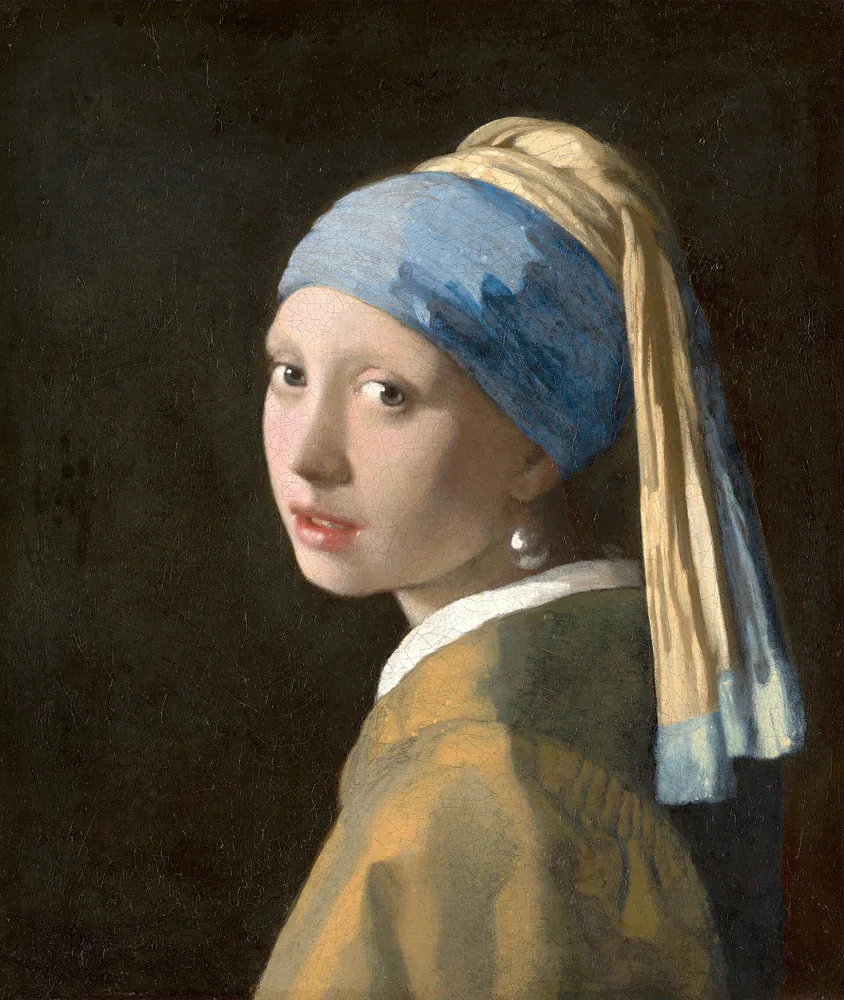
Girl with a Pearl Earring
Painted around 1665 by the Dutch Golden Age master Johannes Vermeer, Girl with a Pearl Earring is an oil painting capturing a young woman turning toward the viewer against a dark background. She wears an exotic turban, an ochre jacket, and a prominent, luminous earring. Rather than being a conventional formal portrait, the piece belongs to the Dutch tronie genre, presenting an idealized study of facial expression and costume. Vermeer composed the work with delicate handling of light, soft transitions, and sharp reflective glints on the jewelry and her parted lips. The artwork went by various names over the centuries before officially adopting its current title late in the twentieth century. Conserved in the collection of the Mauritshuis in The Hague since 1902, the painting has captivated audiences worldwide and inspired modern literary and cinematic works.
Look for
- The large, softly gleaming earring catching highlights against her neck
- The blue and yellow turban framing her face against a dark backdrop
- Her parted lips, captured as if she is about to speak while turning
The Daily Quiz
5 questions from today's reading. Pick an answer to see if you're right.
-
Which two painting techniques were devised by French artist Georges Seurat?
Answer
Chromoluminarism and pointillism. Georges Seurat devised the techniques known as chromoluminarism and pointillism, initiating the Neo-Impressionist movement.
-
During which decade did Pop art first emerge in the United Kingdom and the United States?
Answer
Mid-to-late 1950s. Pop art emerged during the mid-to-late 1950s as a movement that challenged traditional fine art through popular culture imagery.
-
Whose collection of paintings formed the foundation of the Hermitage Museum in 1764?
Answer
Johann Ernst Gotzkowsky. The State Hermitage Museum was founded in 1764 when Empress Catherine the Great acquired paintings from Berlin merchant Johann Ernst Gotzkowsky.
-
What is the literal translation of the Japanese art term ukiyo-e?
Answer
Pictures of the floating world. The Japanese term ukiyo-e translates literally to 'pictures of the floating world'.
-
Where was Michelangelo born before becoming active primarily in Rome from his thirties onwards?
Answer
Republic of Florence. Michelangelo was born in the Republic of Florence, though he lived and worked mostly in Rome from his thirties onward.
Puzzle Corner
Who am I?
- I was part of 'The Five', a spiritual circle of women who sought contact with the 'High Masters' through séances.
- My paintings, which sometimes resembled complex diagrams, visualized spiritual ideas drawn from Theosophy.
- My vast body of non-objective work predated the celebrated abstract compositions of Kandinsky, Malevich, and Mondrian.
- I was a Swedish painter and mystic whose creations are recognized among the earliest abstract works in Western art history.
Reveal the answer
Hilma af Klint. Hilma af Klint was a pioneering Swedish artist whose mystical, spiritual paintings helped establish Western abstract art. Wikipedia →
Scrambled masters
NENORAFD OORBTE
Colombian artist whose signature style depicted figures and forms in large, exaggerated volumes.
Show answer
Fernando Botero Wikipedia →
RDIAF ALOKH
Mexican painter known for autobiographical self-portraits exploring identity, chronic pain, and folk traditions.
Show answer
Frida Kahlo Wikipedia →
YAMR ATTACSS
American painter who exhibited with the Impressionists and depicted tender bonds between mothers and children.
Show answer
Mary Cassatt Wikipedia →
Word of the Day
Etching
ECH-ing
A printmaking process where an artist draws lines through an acid-resistant ground onto a metal plate, allowing acid to bite incised grooves into the exposed metal.
Example: Etching remains a vital old master printmaking method, celebrated for its fluid, needle-drawn lines.
Wikipedia →Daily features are written by ArtSleuth's AI (Google Gemini) from the linked Wikipedia articles. Paintings: public domain, via Wikimedia Commons.