The ArtSleuth Chronicle
“Curated insights from the world of art.”
Edition of November 14, 2026
On This Day
-
1691
Died
Tosa Mitsuoki died, having revived the Tosa school of painting and relocated it to Kyoto to regain standing in the imperial court.
Wikipedia → -
1840
Born
French master Claude Monet was born, going on to pioneer plein air landscape painting and found Impressionism.
Wikipedia → - 1878
-
1897
Born
American Regionalist painter John Steuart Curry was born, famous for depicting rural life, farm scenes, and storms in Kansas.
Wikipedia →
Artwork of the Day
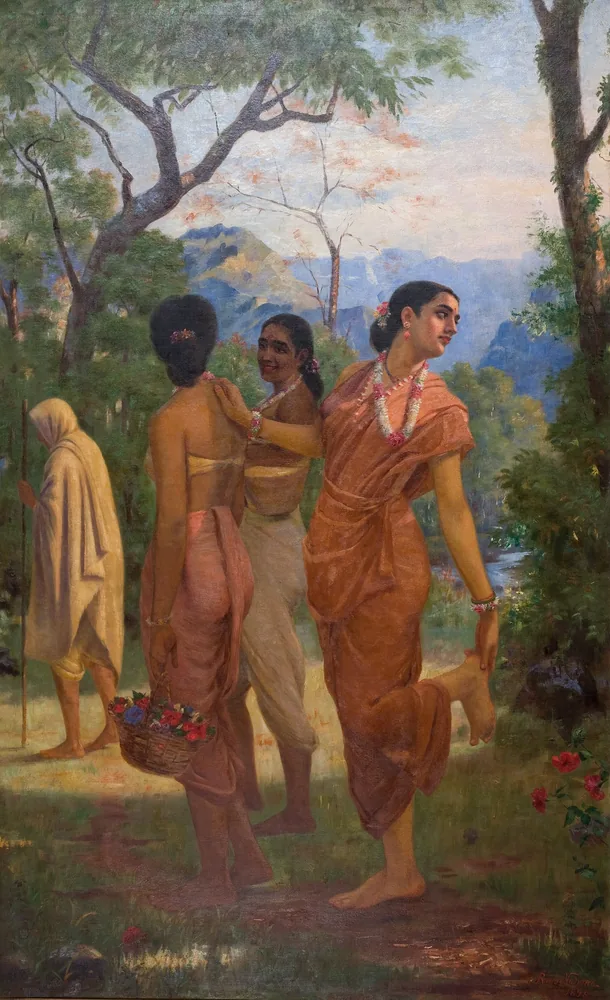
Shakuntala
Painted in 1898, Shakuntala (also known as Shakuntala looking for Dushyanta) is an epic canvas by Indian master Raja Ravi Varma. The painting illustrates a celebrated episode from the Mahabharata, depicting Shakuntala feigning the need to extract a thorn from her foot. In reality, her hesitation is an excuse to glance backward and catch sight of her beloved husband, King Dushyanta, while her companions playfully call her bluff. Though the male protagonist remains entirely absent from the scene, his unseen presence drives the narrative. Art historian Tapati Guha-Thakurta observed that Shakuntala's twisted pose acts like a dramatic film still, pulling the viewer directly into the evolving story. The work remains an influential masterpiece in Indian art history, demonstrating how academic realism could visualize classical epic narrative while exploring how feminine subjects were shaped by the focal point of the male gaze.
Look for
- The contorted posture of Shakuntala turning back as if tending to her foot
- The teasing expressions of her companions noticing her romantic ruse
- The lush outdoor landscape that frames the absent figure of Dushyanta
The Daily Quiz
5 questions from today's reading. Pick an answer to see if you're right.
-
Which visual artist is associated with the post-World War II movement of Minimalism?
Answer
Donald Judd. Donald Judd is cited alongside artists such as Agnes Martin, Dan Flavin, and Carl Andre as prominent figures in minimalism.
-
Which pope founded the Vatican Museums in the early 16th century?
Answer
Pope Julius II. Pope Julius II founded the Vatican Museums in the early 16th century.
-
Which artists developed the painting technique known as Pointillism in 1886?
Answer
Georges Seurat and Paul Signac. Georges Seurat and Paul Signac created Pointillism in 1886 as a branch of Impressionism.
-
Before serving the Duke of Burgundy, Jan van Eyck worked as painter and valet de chambre to which ruler around 1422?
Answer
John III the Pitiless. Jan van Eyck was employed around 1422 by John III the Pitiless, ruler of Holland and Hainaut.
-
Critic Gustave Geffroy counted Mary Cassatt as one of 'les trois grandes dames' of Impressionism along with which artist?
Answer
Berthe Morisot. Geffroy named Cassatt, Marie Bracquemond, and Berthe Morisot as the three great ladies of Impressionism.
Puzzle Corner
Who am I?
- In August 1931, I completed a landmark painting titled The Persistence of Memory.
- Though trained in Madrid with early interests in Impressionism and Cubism, I formally joined the Surrealist group in 1929.
- During the Spanish Civil War I resided in France before moving in 1940 to the United States.
- Born in Figueres, Catalonia, I became one of the most famous Spanish Surrealists, celebrated for my draftsmanship and bizarre imagery.
Reveal the answer
Salvador Dalí. I am Salvador Dalí, the Spanish Surrealist master famous for works such as The Persistence of Memory. Wikipedia →
Scrambled masters
RADDEW HPRPOE
American realist painter of modern urban isolation and the 1942 classic Nighthawks.
Show answer
Edward Hopper Wikipedia →
BRHALTCE EDRRU
German Renaissance printmaker and theorist from Nuremberg known for masterly woodcuts and engravings.
Show answer
Albrecht Dürer Wikipedia →
IRAGEOG EFOEKEF
Modernist painter hailed as the Mother of American modernism, celebrated for depictions of flowers and desert hills.
Show answer
Georgia O'Keeffe Wikipedia →
Word of the Day
En plein air
ahn-plehn-AIR
The practice of painting outdoors directly from nature rather than in a studio. This approach allows artists to observe and capture changing conditions of natural light, weather, and atmosphere.
Example: Claude Monet's plein air landscape painting Impression, Sunrise (1874).
Wikipedia →Daily features are written by ArtSleuth's AI (Google Gemini) from the linked Wikipedia articles. Paintings: public domain, via Wikimedia Commons.