The ArtSleuth Chronicle
“Curated insights from the world of art.”
Edition of November 12, 2026
On This Day
-
1840
Born
French sculptor Auguste Rodin, a pioneer of modern sculpture, was recognized for expressive masterpieces such as The Thinker, The Kiss, and The Gates of Hell.
Wikipedia → -
1881
Born
Estonian architect Olev Siinmaa shaped the style known as Pärnu Resort Functionalism and co-designed landmark works including the Pärnu Beach Hotel.
Wikipedia → -
1933
Died
American photographer and publisher F. Holland Day was a leading Pictorialist who campaigned vigorously for the acceptance of photography as a fine art.
Wikipedia → -
1965
Died
French painter Many Benner, who trained at the École des Beaux-Arts, twice achieved second place in the prestigious Grand Prix de Rome competition.
Wikipedia →
Artwork of the Day
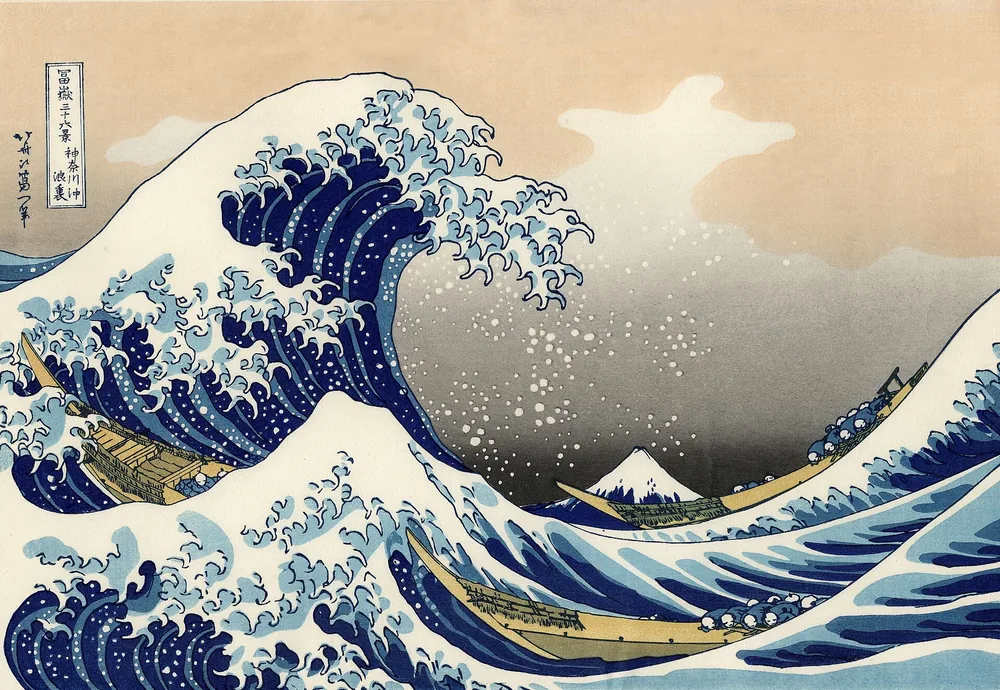
The Great Wave off Kanagawa
Created in late 1831 during Japan's Edo period, The Great Wave off Kanagawa is a celebrated woodblock print by ukiyo-e master Katsushika Hokusai. The dynamic composition portrays three boats navigating a turbulent, storm-tossed sea beneath a towering cresting wave that spirals across the center, framing Mount Fuji in the distance. Hokusai achieved a groundbreaking synthesis of traditional Japanese printmaking and Western graphical perspective, capturing nature's dramatic power with bold technical innovation. A defining feature of the print was its innovative use of imported Prussian blue pigment, which thoroughly revolutionized printmaking in Japan. Serving as the opening image in Hokusai's celebrated series Thirty-six Views of Mount Fuji, the work achieved immediate critical and commercial success across Japan. It subsequently gained worldwide renown, inspiring European Impressionist painters and entering the permanent collections of major museums across the globe as one of the most recognized images in world art history.
Look for
- The towering cresting wave forming a dynamic spiral over the water
- Mount Fuji appearing small and serene against the distant horizon
- Three slender boats manned by rowers cutting through the stormy swells
The Daily Quiz
4 questions from today's reading. Pick an answer to see if you're right.
-
Which technique did Albrecht Dürer prefer for his later prints?
Answer
Engraving. Dürer's vast body of work includes engravings, which became his preferred medium for his later print series.
-
Which two architects designed the buildings of the Van Gogh Museum in Amsterdam?
Answer
Gerrit Rietveld and Kisho Kurokawa. The Van Gogh Museum opened in 1973 with buildings designed by Gerrit Rietveld and Kisho Kurokawa.
-
What binding agent is most commonly used in the manufacture of gouache paint?
Answer
Gum arabic or dextrin. Gouache is a water-medium paint bound predominantly by gum arabic or dextrin.
-
In which city did Caspar David Friedrich study between 1794 and 1798 before settling in Dresden?
Answer
Copenhagen. Friedrich pursued his studies in Copenhagen before establishing his artistic career in Dresden.
Puzzle Corner
Who am I?
- The wild intensity of my colours between 1900 and 1905 earned me notoriety as a leader of the Fauves.
- Along with Pablo Picasso, I am credited with defining the revolutionary developments in the visual arts in the early twentieth century.
- After 1906, I turned toward a rigorous style emphasizing flattened forms, fluid draughtsmanship, and decorative patterns.
- Though accomplished in printmaking and sculpture, I am celebrated above all as a French master of modern painting.
Reveal the answer
Henri Matisse. You are Henri Matisse, one of the seminal figures of modern art and a master of expressive color. Wikipedia →
Scrambled masters
GOEDI VULZZEQEA
Leading Spanish Golden Age court painter to King Philip IV whose masterworks include Las Meninas.
Show answer
Diego Velázquez Wikipedia →
FNRANDOE OTRBEO
Colombian painter and sculptor renowned for rendering figures and objects in exaggerated volume.
Show answer
Fernando Botero Wikipedia →
RMAY CATSSAT
American painter and printmaker who exhibited with the Impressionists and depicted the intimate lives of women.
Show answer
Mary Cassatt Wikipedia →
Word of the Day
Tenebrism
TEN-uh-briz-um
A painting style characterized by extreme chiaroscuro with violent contrasts between bright highlights and dominating dark shadows, often creating a dramatic spotlight effect.
Example: The early Spanish Baroque paintings of Diego Velázquez.
Wikipedia →Daily features are written by ArtSleuth's AI (Google Gemini) from the linked Wikipedia articles. Paintings: public domain, via Wikimedia Commons.