The ArtSleuth Chronicle
“Curated insights from the world of art.”
Edition of October 22, 2026
On This Day
-
1882
Born
American illustrator and realist painter N. C. Wyeth was born; he created over 3,000 paintings and illustrated beloved classics such as Treasure Island.
Wikipedia → -
1906
Died
French Post-Impressionist painter Paul Cézanne died, leaving behind a radical structural style that bridged late 19th-century Impressionism and early 20th-century Cubism.
Wikipedia → -
1925
Born
American artist Robert Rauschenberg was born; he became renowned for his Combines, which merged everyday found objects with painting and sculpture.
Wikipedia → -
2005
Died
French-American artist Arman passed away; he was famous for using real objects as artworks through his celebrated Accumulations and deconstructions.
Wikipedia →
Artwork of the Day
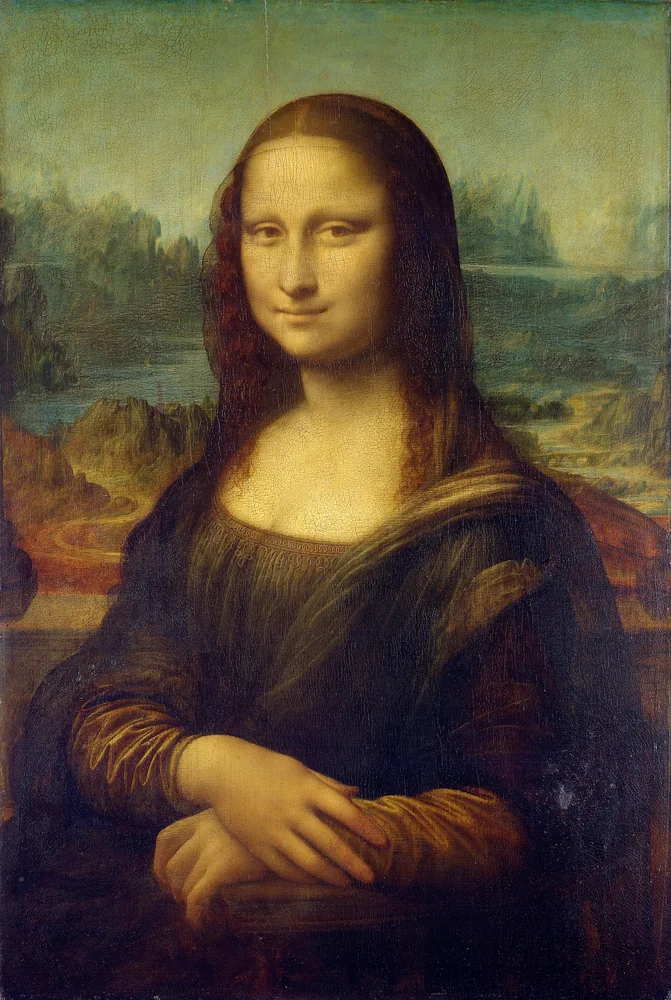
Mona Lisa
The Mona Lisa is a half-length portrait painted in oil on a white poplar panel by Italian Renaissance master Leonardo da Vinci between circa 1503 and 1519. The work is traditionally considered to depict the Italian noblewoman Lisa del Giocondo, though Leonardo never actually delivered the finished piece to the Giocondo family. Renowned as an archetypal masterpiece of the Italian Renaissance, it has been celebrated as the most visited, written about, sung about, and parodied artwork in the world. Its fame rests on Leonardo's innovative techniques, including the monumentality of the overall composition, the subtle modelling of sculptural forms, and an immersive atmospheric illusionism. Combined with the sitter's profoundly enigmatic expression, the portrait established an enduring standard for psychological depth and technical virtuosity that fundamentally transformed the course of Western portraiture.
Look for
- The sitter's enigmatic expression
- Subtle modelling of forms across the face and hands
- Atmospheric illusionism in the landscape background
The Daily Quiz
5 questions from today's reading. Pick an answer to see if you're right.
-
Which painter's workshop is Raphael believed to have trained in before being recognized as a master by 1500?
Answer
Pietro Perugino. Raphael probably trained in the workshop of Pietro Perugino before being described as a fully trained master.
-
In which former industrial building is Tate Modern situated?
Answer
Bankside Power Station. Tate Modern is housed in the former Bankside Power Station located in the Bankside area of Southwark.
-
How did Leonardo da Vinci famously characterize the sfumato technique?
Answer
Without lines or borders, in the manner of smoke. Leonardo described sfumato as being 'without lines or borders, in the manner of smoke'.
-
What dramatic lighting technique became Caravaggio's dominant stylistic element?
Answer
Tenebrism. Caravaggio employed dramatic chiaroscuro known as tenebrism, transfixing figures in bright light against dark shadows.
-
When did the Pop art movement originally emerge in the United Kingdom and the United States?
Answer
Mid-to-late 1950s. Pop art emerged in both the United Kingdom and the United States during the mid-to-late 1950s.
Puzzle Corner
Who am I?
- I am celebrated not only as a prodigious 20th-century painter but also as one of the century's most gifted master forgers.
- By the 1960s, I expanded my artistic range to gain renown as a modern impressionist and expressionist.
- I initially established my reputation as a traditionalist painter working in the guohua style.
- I was born in 1899 and became one of the best-known Chinese artists of my era.
Reveal the answer
Zhang Daqian. Zhang Daqian was a renowned 20th-century Chinese artist celebrated for traditional guohua painting, modern impressionism, and remarkably skilled master forgeries. Wikipedia →
Scrambled masters
GRAED AGEDS
French artist who rejected the Impressionist label, celebrated for his dynamic drawings and paintings of ballet dancers.
Show answer
Edgar Degas Wikipedia →
TPEI ADMOINRN
Dutch abstract pioneer who reduced his visual language to simple geometric elements in pursuit of universal values.
Show answer
Piet Mondrian Wikipedia →
IDEGO QVZUELEAZ
Leading Spanish Baroque painter at the court of King Philip IV and creator of the 1656 masterpiece Las Meninas.
Show answer
Diego Velázquez Wikipedia →
Word of the Day
Grisaille
griz-EYE
A method of painting executed entirely in monochrome shades of grey or neutral greyish tones. It is frequently employed in decorative schemes to imitate relief sculpture, as an underpainting for oil glazes, or as a model for engravers.
Example: Sketches created by Peter Paul Rubens and his workshop to guide printmakers and engravers.
Wikipedia →Daily features are written by ArtSleuth's AI (Google Gemini) from the linked Wikipedia articles. Paintings: public domain, via Wikimedia Commons.