The ArtSleuth Chronicle
“Curated insights from the world of art.”
Edition of October 21, 2026
On This Day
-
1765
Died
Italian Baroque veduta painter Giovanni Paolo Panini, celebrated for his vistas of Rome and depictions of picture galleries, died.
Wikipedia → -
1911
Born
American illustrator and animator Mary Blair, known for her concept art for Disney films and iconic park attractions, was born.
Wikipedia → -
1959
Event
The landmark Frank Lloyd Wright-designed Solomon R. Guggenheim Museum opened to the public in New York City.
Wikipedia → -
1995
Died
American sculptor and painter Nancy Graves, acclaimed for works depicting natural phenomena and maps of the Moon, died.
Wikipedia →
Artwork of the Day
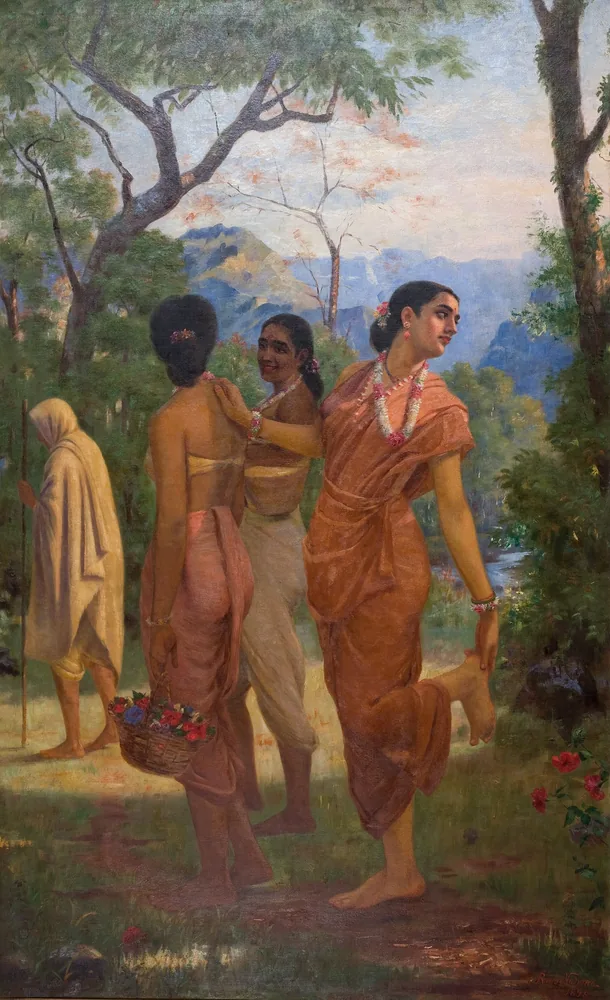
Shakuntala
Painted in 1898 by Indian artist Raja Ravi Varma, Shakuntala—also known as Shakuntala looking for Dushyanta—depicts an important character from the ancient epic Mahabharata. Ravi Varma captures a nuanced moment of romantic drama: Shakuntala feigns pausing to pull a thorn from her foot, but her true intention is to cast a longing backward glance at her lover, Dushyantha. Beside her, companions notice the playful deception and tease her. Art historian Tapati Guha-Thakurta has observed that the physical twist of Shakuntala's body pulls the viewer directly into the ongoing narrative, creating a frozen tableau reminiscent of a still from a moving film. Although Dushyantha is entirely absent from the picture frame, his presence serves as the unseen focal point for her gaze, demonstrating how feminine representation in the narrative is framed around the lover.
Look for
- The contorted posture of Shakuntala as she twists back while pretending to tend to her foot.
- The teasing companions observing her actions and calling her bluff.
- The implied presence of Dushyantha beyond the frame toward whom her gaze turns.
The Daily Quiz
5 questions from today's reading. Pick an answer to see if you're right.
-
Which Spanish monarch employed Diego Velázquez as his leading court painter?
Answer
King Philip IV. Velázquez served as the leading artist in the court of King Philip IV of Spain and Portugal.
-
What proportion of materials characterizes an artistic glaze?
Answer
A large amount of binding medium with very little pigment. Glazes consist of a large amount of binding medium relative to a very small quantity of pigment.
-
Which two art movements did Paul Cézanne's work bridge?
Answer
Impressionism and Cubism. Cézanne formed the bridge between late 19th-century Impressionism and early 20th-century Cubism.
-
Who first applied the term 'abstract expressionism' to American art in 1946?
Answer
Robert Coates. Art critic Robert Coates first applied the term to American art in 1946.
-
In which former industrial building is Tate Modern situated?
Answer
Bankside Power Station. Tate Modern is housed in the former Bankside Power Station in London's Southwark borough.
Puzzle Corner
Who am I?
- I helped broaden the ukiyo-e style from portraits of actors and courtesans to encompass landscapes, plants, and animals.
- My masterworks deeply influenced European artists like Vincent van Gogh and Claude Monet during the wave of Japonisme.
- Spurred by a domestic travel boom, I produced a celebrated woodblock series of thirty-six views honoring a sacred peak.
- A towering wave rising off Kanagawa stands as the most famous creation of my career.
Reveal the answer
Hokusai. I am Katsushika Hokusai, the master Japanese painter and printmaker of the Edo period. Wikipedia →
Scrambled masters
PITE DNMRINOA
Dutch abstract pioneer who reduced his visual language to utopian geometric elements.
Show answer
Piet Mondrian Wikipedia →
CADLEU EMOTN
French founder of Impressionism whose 1874 sunrise painting gave the movement its name.
Show answer
Claude Monet Wikipedia →
RSVAOALD LAID
Spanish surrealist master celebrated for precise draftsmanship and melting clocks.
Show answer
Salvador Dalí Wikipedia →
Word of the Day
Woodcut
WOOD-kut
A relief printmaking method where an artist carves an image along the grain of a wooden block, removing non-printing areas so that raised surfaces receive ink from a roller.
Example: The Great Wave off Kanagawa by Katsushika Hokusai
Wikipedia →Daily features are written by ArtSleuth's AI (Google Gemini) from the linked Wikipedia articles. Paintings: public domain, via Wikimedia Commons.