The ArtSleuth Chronicle
“Curated insights from the world of art.”
Edition of October 12, 2026
On This Day
-
1492
Died
Italian Renaissance master Piero della Francesca died, remembered for his serene humanism, use of geometry and perspective, and the fresco cycle The History of the True Cross.
Wikipedia → -
1654
Died
Dutch painter Carel Fabritius, a gifted pupil of Rembrandt known for The Goldfinch and his pioneering experiments with perspective and lighting, died.
Wikipedia → -
1858
Died
Japanese ukiyo-e master Hiroshige died, famed for his poetic landscape series The Fifty-three Stations of the Tōkaidō and One Hundred Famous Views of Edo.
Wikipedia → -
1934
Born
Pritzker Prize-winning American architect Richard Meier, acclaimed for his pristine white geometric designs including the Getty Center, was born.
Wikipedia →
Artwork of the Day
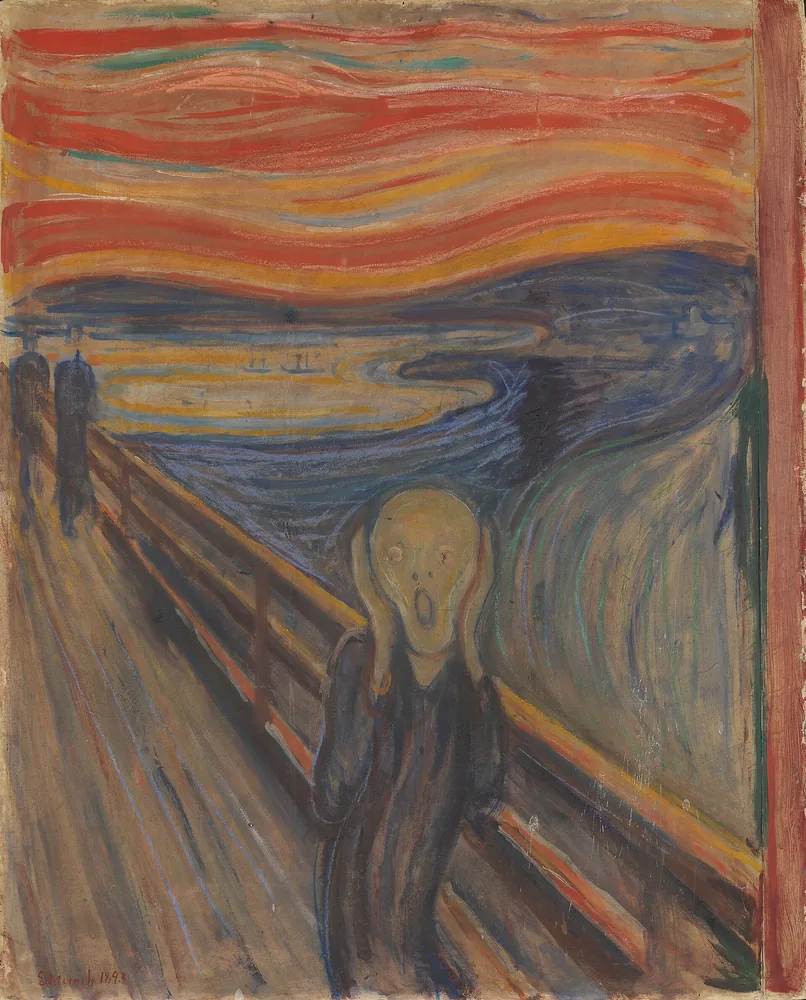
The Scream
Created in 1893 by Norwegian artist Edvard Munch, The Scream portrays a pale, agonized figure clutching its head in distress on a bridge. Munch drew inspiration from an evening walk along a fjord path overlooking Oslo. As the setting sun abruptly turned the evening clouds a startling blood-red, he experienced what he described as an infinite scream passing through nature. Scholars have linked this fiery sky both to actual atmospheric phenomena, such as volcanic eruptions, and to the artist's personal emotional distress regarding his sister's hospitalization at a nearby asylum. Later recreated by Munch in multiple versions, the composition rejected mere realism in favor of pure psychological sensation, serving as a cornerstone for the emerging Expressionist movement. Today, the painting remains an enduring global symbol of human existential dread.
Look for
- The swirling, blood-red sky above the fjord path
- The elongated, agonized figure holding its head
- Two distant figures walking along the straight railing
The Daily Quiz
5 questions from today's reading. Pick an answer to see if you're right.
-
Which major movement did Georges Seurat initiate with his painting A Sunday Afternoon on the Island of La Grande Jatte?
Answer
Neo-Impressionism. Seurat launched Neo-Impressionism through his innovative techniques and his monumental canvas A Sunday Afternoon on the Island of La Grande Jatte.
-
Which artist married Jackson Pollock in 1945 and significantly shaped his career and legacy?
Answer
Lee Krasner. Pollock married fellow artist Lee Krasner in 1945, and she became a major influence on his life and work.
-
Along which famous thoroughfare is the main building of the Metropolitan Museum of Art located?
Answer
Fifth Avenue. The Met's main building is situated at 1000 Fifth Avenue on the Museum Mile in Manhattan.
-
What movement did Romanticism primarily arise in response to in late 18th-century Europe?
Answer
The Age of Enlightenment and the Industrial Revolution. Romanticism developed as an intellectual and artistic reaction against the Age of Enlightenment and the rise of industrialization.
-
From which language is the artistic term 'anamorphosis' derived?
Answer
Greek. The term comes from the Greek prefix ana- and the word morphe.
Puzzle Corner
Who am I?
- I began formal lessons at age eight and gained early acclaim at nineteen with my 1932 painting Young Girls.
- My work drew deeply on precolonial Indian styles and everyday scenes of local life, though I also lived and worked in Europe.
- Born to Hungarian and Indian heritage, I travelled across Turkey, France, and India throughout my short artistic career.
- Critics revere me as an avant-garde pioneer of modern Indian art.
Reveal the answer
Amrita Sher-Gil. You are reading about Amrita Sher-Gil, the pioneering Hungarian-Indian painter. Wikipedia →
Scrambled masters
EARDDV HUCMN
Norwegian painter who drew on personal trauma to create expressive masterworks like The Scream.
Show answer
Edvard Munch Wikipedia →
NRDSOA LLBIIETTCO
Early Renaissance master admired for graceful mythologies like Primavera and The Birth of Venus.
Show answer
Sandro Botticelli Wikipedia →
GIOED EZQVZALUE
Spanish Golden Age court painter to King Philip IV whose crowning masterpiece is Las Meninas.
Show answer
Diego Velázquez Wikipedia →
Word of the Day
Scumbling
SKUM-bling
An oil painting technique in which a thin, opaque or semi-opaque layer of dry paint is lightly brushed over another color to subtly alter its hue and texture.
Example: J. M. W. Turner, Rain, Steam and Speed
Wikipedia →Daily features are written by ArtSleuth's AI (Google Gemini) from the linked Wikipedia articles. Paintings: public domain, via Wikimedia Commons.