The ArtSleuth Chronicle
“Curated insights from the world of art.”
Today's Edition
October 6, 2026On This Day
-
1887
Born
Pioneering architect and painter Le Corbusier, who helped shape modern architecture and co-founded CIAM, was born in Switzerland.
Wikipedia → -
1913
Born
Swiss Surrealist artist and photographer Méret Oppenheim was born, later becoming an influential figure in the avant-garde.
Wikipedia → -
2014
Died
Polish monumental sculptor Igor Mitoraj, famed for his large-scale fragmented human body installations in public spaces, died at the age of seventy.
Wikipedia → -
2017
Died
British architect David Marks, renowned co-designer of the iconic London Eye and the British Airways i360 tower, passed away.
Wikipedia →
Artwork of the Day
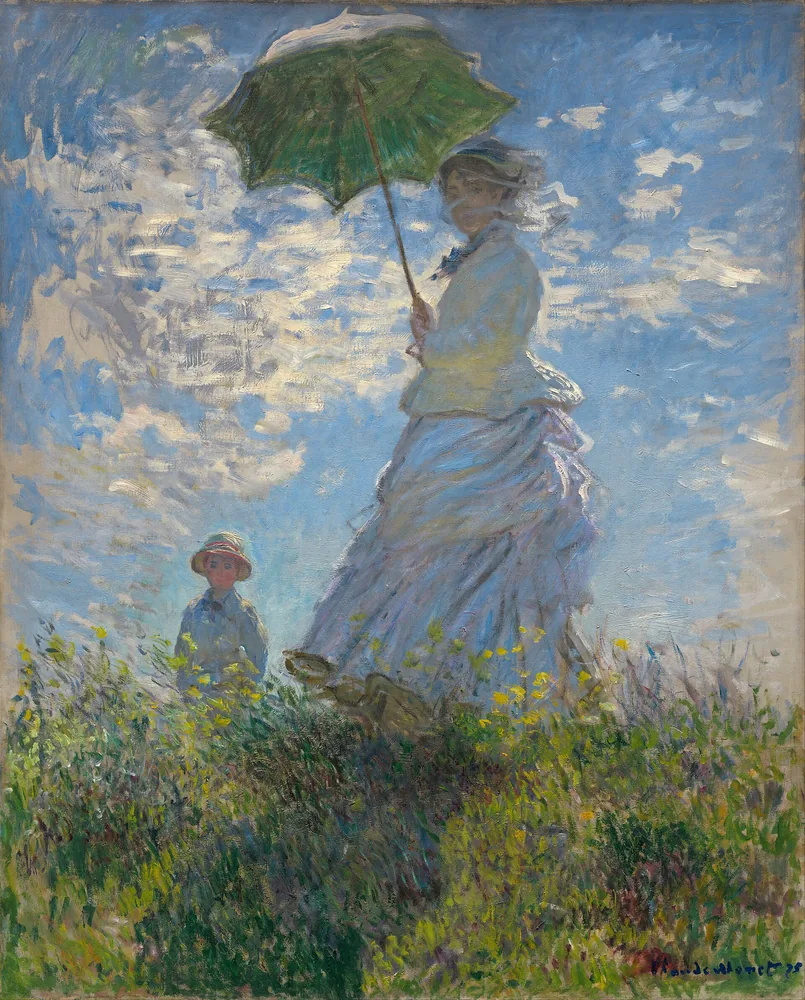
Woman with a Parasol
Painted in 1875, Claude Monet's Woman with a Parasol – Madame Monet and Her Son captures a fleeting outdoor moment on an airy summer's day. Monet depicted his wife Camille and their young son Jean during the family's residence in Argenteuil between 1871 and 1877. Sometimes called The Stroll (La Promenade), this oil-on-canvas work reflects the core pursuits of Impressionism: recording the transient effects of light, atmosphere, and movement in the open air. Rather than creating a formal portrait, Monet caught his figures mid-walk atop a grassy rise, framed against an expansive sky. The breezy setting allows the figures to blend naturally into the surrounding landscape. The painting is recognized as an exemplary Impressionist achievement, showcasing how everyday domestic strolls could be transformed into compelling studies of light, air, and family life.
Look for
- Camille holding a parasol on a windy day
- Their young son Jean standing nearby
- The grassy landscape in Argenteuil under an open sky
The Daily Quiz
5 questions from today's reading. Pick an answer to see if you're right.
-
Which architect founded the influential Bauhaus school in Weimar in 1919?
Answer
Walter Gropius. Walter Gropius founded the Bauhaus in Weimar based on the idea of creating a Gesamtkunstwerk.
-
What is Belgian surrealist René Magritte primarily celebrated for depicting in his art?
Answer
Familiar objects set in unfamiliar, unexpected contexts. Magritte is famed for placing ordinary objects into unexpected settings to question the boundaries of reality and representation.
-
From which language does the English term 'still life' originate?
Answer
Dutch. The English term 'still life' derives from the Dutch word 'stilleven'.
-
Who is the single most extensively represented artist in the Museo del Prado?
Answer
Francisco Goya. Francisco Goya is recorded as the single most extensively represented artist in the Museo del Prado's collection.
-
What signature characteristic defines Fernando Botero's style, known as 'Boterismo'?
Answer
Large, exaggerated volume in figures and people. Botero's signature Boterismo style is recognized for depicting people and figures in large, exaggerated volume.
Puzzle Corner
Who am I?
- I was an expatriate painter at the court of King Charles I in London from 1638 until around 1642, before resurfacing in Naples in 1649.
- I shattered institutional barriers by becoming the first female member of the Accademia di Arte del Disegno in Florence.
- Initially working in the dramatic style of Caravaggio, I had begun producing professional works by the age of fifteen.
- I was a celebrated 17th-century Italian Baroque painter whose international clientele sought my powerful, masterfully crafted canvases.
Reveal the answer
Artemisia Gentileschi. I am Artemisia Gentileschi, the renowned Italian Baroque master who broke barriers across seventeenth-century Europe. Wikipedia →
Scrambled masters
GOIGEAR FFOEKEE
Called the Mother of American modernism, renowned for depictions of desert landscapes and flowers.
Show answer
Georgia O'Keeffe Wikipedia →
ZAIRIKM HLAMIEVC
Russian avant-garde pioneer who founded Suprematism, a radically non-objective art form introduced in 1915.
Show answer
Kazimir Malevich Wikipedia →
DNAY HOWARL
Leading pop art figure who explored commercialism and popularized the phrase 15 minutes of fame.
Show answer
Andy Warhol Wikipedia →
Word of the Day
Pointillism
POYN-tih-liz-um
A painting technique where small, distinct dots of color are methodically applied in patterns to form a unified image. Developed from Impressionism, the method gave rise to Neo-impressionism.
Example: The technique was pioneered by Georges Seurat in 1886.
Wikipedia →Daily features are written by ArtSleuth's AI (Google Gemini) from the linked Wikipedia articles. Paintings: public domain, via Wikimedia Commons.