The ArtSleuth Chronicle
“Curated insights from the world of art.”
Today's Edition
October 5, 2026On This Day
-
1524
Died
Flemish painter Joachim Patinir, who pioneered landscape as an independent genre and invented the panoramic world landscape style, died.
Wikipedia → -
1712
Born
Francesco Guardi, one of the last masters of the classic Venetian school known for his spirited brushwork and atmospheric vedute, was born.
Wikipedia → -
1939
Born
German neo-expressionist painter and sculptor A. R. Penck, celebrated for his visual style recalling primitive art, was born.
Wikipedia → -
1959
Born
American architect and sculptor Maya Lin, designer of the influential Vietnam Veterans Memorial and the Civil Rights Memorial, was born.
Wikipedia →
Artwork of the Day
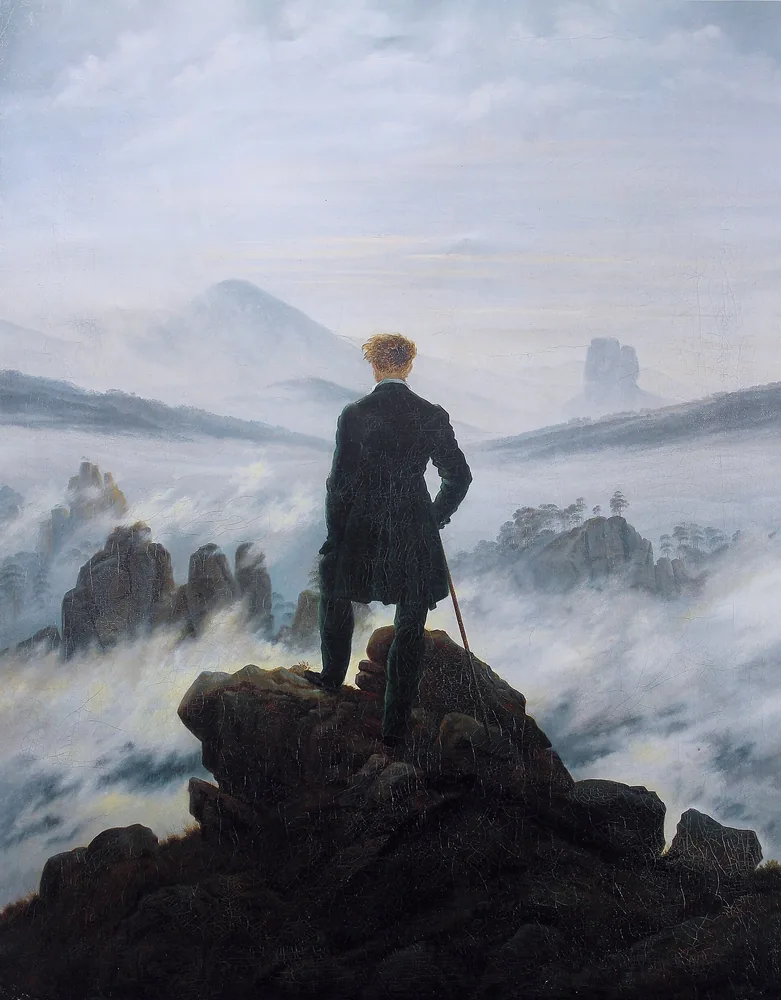
Wanderer above the Sea of Fog
Painted around 1818 by the German Romantic artist Caspar David Friedrich, Wanderer above the Sea of Fog presents a solitary traveler perched atop a rocky crag, looking outward over a vast expanse of swirling mist. Friedrich crafted the composition as a quintessential Rückenfigur, depicting the central figure entirely from behind so viewers see through his eyes and share in his contemplative encounter. Ridges, craggy peaks, and distant trees pierce the swirling fog, stretching endlessly toward an obscured horizon. Made during the height of the Romantic era, the painting captures the concept of the sublime—the awe and humble vulnerability felt before the grandeur of untamed nature. It has long been interpreted as an emblem of self-reflection, a meditation on life's path, and an expression of German liberal sentiment, standing today as one of Romanticism's most iconic masterpieces.
Look for
- The prominent rear-facing figure (Rückenfigur) standing atop the central dark crag.
- Jagged mountain ridges and treetops piercing through the thick blanket of mist.
- The faint, distant horizon where the boundless fog dissolves into the pale sky.
The Daily Quiz
5 questions from today's reading. Pick an answer to see if you're right.
-
Which established artist served as an early mentor to Austrian Expressionist painter Egon Schiele?
Answer
Gustav Klimt. Gustav Klimt was a figurative painter of the early 20th century who acted as a mentor to Egon Schiele.
-
Which visual characteristic came to define the unique style of Cuban artist Wifredo Lam?
Answer
Prominent hybrid figures. Wifredo Lam melded various influences into a distinctive style characterized by the prominence of hybrid figures.
-
The post-World War II movement of Minimalism is often interpreted as a reaction against which style?
Answer
Abstract expressionism. Minimalism emerged in Western art as a reaction against abstract expressionism and modernism.
-
What is the specialized term for a woodcut printed using separate blocks and colored inks to produce light-dark contrasts?
Answer
Chiaroscuro woodcut. Chiaroscuro woodcut refers to colour woodcuts printed using different blocks, each inked in a distinct colour.
-
Where is the Tokyo National Museum located?
Answer
Ueno Park. The Tokyo National Museum is located in Ueno Park within the Taitō ward of Tokyo.
Puzzle Corner
Who am I?
- I relied on subtle gradations and multiple block impressions to evoke poetic, ambient landscapes rather than dramatic formal designs.
- Unlike peers who focused on courtesans and theater quarters, I turned the landscape itself into the celebrated subject of Edo print culture.
- I created the vertical masterpiece series One Hundred Famous Views of Edo after being inspired by Hokusai's views of Mount Fuji.
- I am the Japanese master celebrated for the famed horizontal print series The Fifty-three Stations of the Tōkaidō.
Reveal the answer
Hiroshige. Utagawa Hiroshige was the preeminent master of late ukiyo-e woodblock landscapes. Wikipedia →
Scrambled masters
RGAED SDAEG
French artist famed for pastels, sculptures, and kinetic studies of ballet dancers and racehorses.
Show answer
Edgar Degas Wikipedia →
ITNAIT
Master of the Venetian Renaissance celebrated for his versatile subjects and groundbreaking use of color.
Show answer
Titian Wikipedia →
ERSEGGO RATUES
French Neo-Impressionist who pioneered pointillism and painted A Sunday Afternoon on the Island of La Grande Jatte.
Show answer
Georges Seurat Wikipedia →
Word of the Day
Tenebrism
TEN-uh-briz-um
A style of painting using violent contrasts of light and dark, in which deep darkness becomes the dominant feature of the image to create a spotlight effect. Unlike broader chiaroscuro, it is employed specifically to achieve an intense, theatrical impact.
Example: Commonly seen in Baroque paintings, such as works influenced by Caravaggio's dramatic spotlights and deep enveloping shadows.
Wikipedia →Daily features are written by ArtSleuth's AI (Google Gemini) from the linked Wikipedia articles. Paintings: public domain, via Wikimedia Commons.