The ArtSleuth Chronicle
“Curated insights from the world of art.”
Today's Edition
October 7, 2026On This Day
-
1591
Born
French architect Pierre Le Muet was born, renowned for châteaux like Tanlay and his architectural treatise on building houses.
Wikipedia → -
1747
Died
Venetian Baroque painter Giulia Lama died, notable for her intense dark style and for being among the first women to study the male nude.
Wikipedia → -
1923
Born
Canadian painter Jean-Paul Riopelle was born, known for his palette-knife mosaic abstractions and leading role in French Lyrical Abstraction.
Wikipedia → -
2009
Died
American photographer Irving Penn died, celebrated for his influential fashion photography, portraits, and still lifes.
Wikipedia →
Artwork of the Day
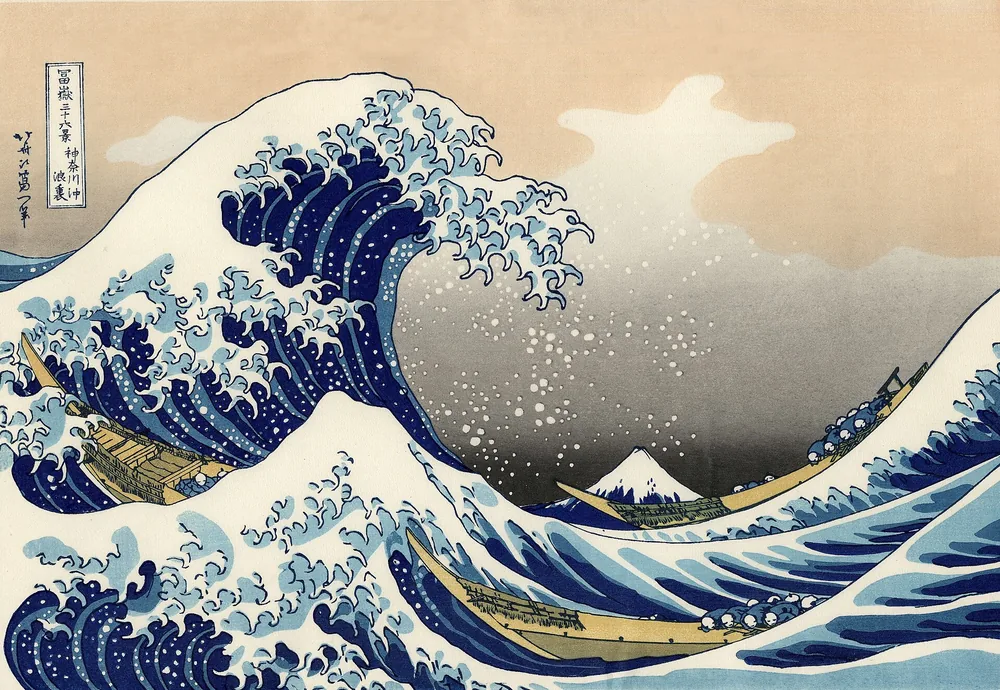
The Great Wave off Kanagawa
Created in late 1831 during Japan's Edo period, 'The Great Wave off Kanagawa' is an iconic woodblock print by Katsushika Hokusai. It depicts three boats navigating a tempestuous sea, dominated by a towering, claw-like cresting wave that forms a dramatic spiral in the centre, with Mount Fuji standing calm and distant in the background. The work served as the opening image in Hokusai's celebrated series Thirty-six Views of Mount Fuji. To produce the print, Hokusai used Prussian blue, a vibrant imported pigment that revolutionised Japanese printmaking. Synthesising traditional Japanese aesthetics with European graphical perspective, the composition immediately achieved immense acclaim in Japan. Later, it spread abroad to Europe, where it made a profound impact on Impressionist painters. Today, multiple prestigious museums worldwide preserve copies of this enduring masterpiece.
Look for
- A large, cresting wave forming a central spiral over the waters
- Three boats battling through the storm-tossed sea
- Mount Fuji positioned small and steady in the distant background
The Daily Quiz
5 questions from today's reading. Pick an answer to see if you're right.
-
What domestic trend in Japan partly inspired Katsushika Hokusai to create Thirty-Six Views of Mount Fuji?
Answer
A domestic travel boom. Hokusai created the series in response to a domestic travel boom in Japan as well as his personal interest in Mount Fuji.
-
Into how many curatorial departments is the permanent collection of the Metropolitan Museum of Art divided?
Answer
17. The Met divides its permanent collection of works across 17 curatorial departments.
-
At which famous German institution did Paul Klee teach alongside Wassily Kandinsky?
Answer
The Bauhaus school. Paul Klee and Wassily Kandinsky both taught at Germany's Bauhaus school of art, design and architecture.
-
In the study of ceramics, what intentional glaze cracking effect is characteristic of Chinese Ge ware?
Answer
Crackle. In ceramic glazes, intentional craquelure is termed 'crackle' and is characteristic of Chinese Ge ware.
-
During which historical period was the term 'Nihonga' coined to distinguish traditional painting from Western-style painting?
Answer
Meiji period. The term Nihonga was coined during the Meiji period (1868–1912) to distinguish Japanese-style painting from Western-style Yōga.
Puzzle Corner
Who am I?
- I frequently used very expensive pigments, yet I produced relatively few paintings and died leaving my wife in debt.
- During my lifetime, I earned my living primarily as an art dealer while working slowly and meticulously as a painter.
- I was considered a moderately successful provincial genre painter recognised in Delft and The Hague.
- I am celebrated as a Dutch Golden Age master known for tranquil domestic interior scenes of middle-class life.
Reveal the answer
Johannes Vermeer. Johannes Vermeer was a master of the Dutch Golden Age whose exquisitely crafted domestic scenes earned lasting renown long after his death. Wikipedia →
Scrambled masters
ADVRED NMHCU
Norwegian painter influenced by bohemian soul painting, famed for his iconic 1893 work The Scream.
Show answer
Edvard Munch Wikipedia →
EDWRDA PREOHP
American realist painter and printmaker who explored solitude in modern urban scenes like Nighthawks.
Show answer
Edward Hopper Wikipedia →
IHSGEIROH
Japanese ukiyo-e master known for The Fifty-three Stations of the Tōkaidō and subtle landscape color.
Show answer
Hiroshige Wikipedia →
Word of the Day
Mosaic
moh-ZAY-ik
An image or pattern created by assembling small pieces of colored stone, glass, or ceramic, affixed to a surface with plaster or mortar. Often applied to floors and walls, this decorative art has been practiced since ancient times.
Example: Pebble mosaics created at Tiryns in Mycenaean Greece, as well as decorative pavements across ancient Rome.
Wikipedia →Daily features are written by ArtSleuth's AI (Google Gemini) from the linked Wikipedia articles. Paintings: public domain, via Wikimedia Commons.