The ArtSleuth Chronicle
“Curated insights from the world of art.”
Today's Edition
October 4, 2026On This Day
-
1669
Died
Dutch Golden Age painter and printmaker Rembrandt died, leaving behind hundreds of masterworks ranging from expressive self-portraits to biblical scenes.
Wikipedia → -
1720
Born
Italian architect and artist Giovanni Battista Piranesi, famed for his etchings of Rome and fictitious, atmospheric prisons, was born.
Wikipedia → -
1814
Born
French painter Jean-François Millet, a founder of the Barbizon school renowned for his Realist depictions of peasant farmers, was born.
Wikipedia → -
1904
Died
French sculptor Frédéric Auguste Bartholdi, celebrated for designing the Statue of Liberty and the monumental Lion of Belfort, passed away.
Wikipedia →
Artwork of the Day
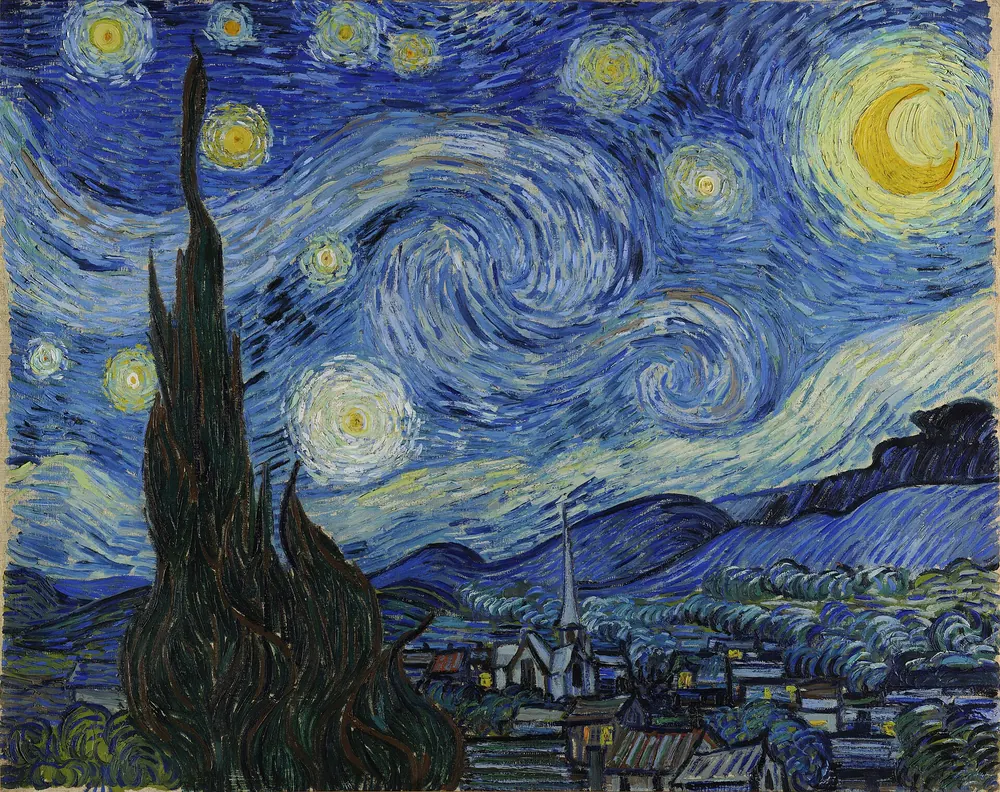
The Starry Night
The Starry Night is a renowned oil-on-canvas painting created by the Dutch Post-Impressionist painter Vincent van Gogh. Executed in mid-June 1889, the artwork depicts the landscape seen from the east-facing bedroom window of his room, capturing the quiet world just before sunrise with the picturesque addition of an imaginary village. The artist produced this piece at the Saint-Paul-de-Mausole mental asylum near Saint-Rémy-de-Provence. This former monastery served as a psychiatric hospital where Van Gogh had voluntarily admitted himself on 8 May 1889, following a severe mental breakdown. Today, the painting is preserved in the permanent collection of the Museum of Modern Art in New York City, where it has resided since 1941 after being acquired through the Lillie P. Bliss Bequest. Celebrated by critics as a touchstone of modern art, this masterwork stands among the most famous and recognizable paintings in the entire Western canon.
Look for
- The view looking out from the east-facing bedroom window
- The morning landscape captured just before sunrise
- The inclusion of an imaginary village
The Daily Quiz
5 questions from today's reading. Pick an answer to see if you're right.
-
What does the French phrase 'trompe-l'œil' literally mean?
Answer
Deceive the eye. In French, the term 'trompe-l'œil' translates directly to 'deceive the eye.'
-
Which leader described Surrealism's aim as resolving the conditions of dream and reality into an absolute reality?
Answer
André Breton. André Breton stated that Surrealism intended to unite dream and reality into an absolute reality, or surreality.
-
Which Florentine painter and sculptor educated Leonardo da Vinci?
Answer
Andrea del Verrocchio. Leonardo da Vinci received his artistic education in Florence under Andrea del Verrocchio.
-
Who negotiated the 'Patto di famiglia' that bequeathed the Medici art collections to Florence?
Answer
Anna Maria Luisa. Anna Maria Luisa, the final Medici heiress, negotiated the family pact that transferred the collection to Florence.
-
At what age was John Constable elected to the Royal Academy of Arts?
Answer
52. Constable was elected to the Royal Academy of Arts at the age of 52.
Puzzle Corner
Who am I?
- I decorated my family's country house, Jas de Bouffan, with early murals influenced by Romanticism.
- I broke academic conventions by altering perspective and emphasizing the underlying geometric structure of objects in my compositions.
- My intense examination of Impressionist expression helped me forge a new pictorial language of formal design.
- History remembers me as the Post-Impressionist master who formed the vital bridge between Impressionism and Cubism.
Reveal the answer
Paul Cézanne. I am Paul Cézanne, the French Post-Impressionist whose innovative compositions bridged nineteenth-century Impressionism and twentieth-century Cubism. Wikipedia →
Scrambled masters
ARCM LLACGHA
Early modernist from Vitebsk who blended Eastern European and Jewish folklore across stained glass, prints, and sets.
Show answer
Marc Chagall Wikipedia →
UEEGNE CLDXAEIOR
French Romantic leader inspired by Rubens and Venetian color who painted dramatic themes and traveled to North Africa.
Show answer
Eugène Delacroix Wikipedia →
EBRTHE OIMRTSO
French Impressionist who debuted at the 1864 Paris Salon and joined the landmark 1874 exhibition at Nadar's studio.
Show answer
Berthe Morisot Wikipedia →
Word of the Day
Chiaroscuro
kee-AH-roh-SKOOR-oh
The use of strong, bold contrasts between light and dark across a composition. It is also a technique employed to achieve a sense of volume when modelling three-dimensional figures.
Example: Drawings created on coloured paper using a dark medium paired with white highlighting, as well as multi-block colour woodcuts.
Wikipedia →Daily features are written by ArtSleuth's AI (Google Gemini) from the linked Wikipedia articles. Paintings: public domain, via Wikimedia Commons.