The ArtSleuth Chronicle
“Curated insights from the world of art.”
Edition of October 3, 2026
On This Day
-
1860
Died
American neoclassical portraitist Rembrandt Peale died, leaving behind acclaimed paintings of early presidents such as George Washington and Thomas Jefferson.
Wikipedia → -
1867
Born
Pierre Bonnard was born; the French painter co-founded Les Nabis and became a central figure bridging Impressionism and Modernism through his decorative color.
Wikipedia → -
1875
Born
Dr. Atl was born; the Mexican painter pioneered modern Mexican art and helped foster muralism with his depictions of volcanic landscapes.
Wikipedia → -
1882
Born
A. Y. Jackson was born; the Canadian landscape painter was a founding member of the Group of Seven and served as a World War I war artist.
Wikipedia →
Artwork of the Day
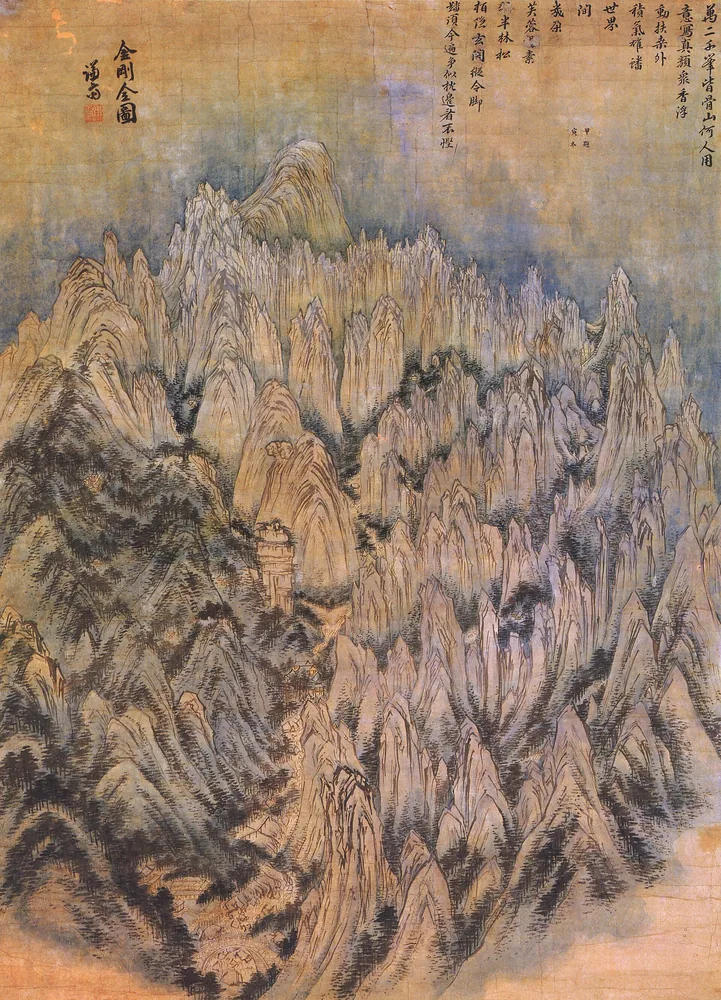
General View of the Diamond Mountains
Painted in 1734 during the reign of King Yeongjo, General View of the Diamond Mountains is a landscape by Korean master Jeong Seon. Also known by its Korean title Geumgang jeondo, meaning a general view of Mount Geumgangsan, the artwork offers a panoramic interpretation of the celebrated rocky range. Jeong Seon captured the rugged geography with bold, expressive inkwork, synthesizing individual peaks into a unified vista. The painting marks a pivotal moment in Korean art history, celebrating local scenery rather than idealized foreign landscapes. Recognized for its historical and aesthetic significance, the masterpiece was designated as the 217th National Treasure of South Korea in 1984. It is owned by Lee Kun-hee and is held and managed by the Ho-Am Art Museum in Yongin, Gyeonggi Province.
Look for
- The sweeping panoramic layout showing the jagged peaks of Mount Geumgangsan
- Dynamic ink brushwork defining the sharp rock formations of the mountain range
- Atmospheric composition uniting individual summits into a singular sweeping view
The Daily Quiz
5 questions from today's reading. Pick an answer to see if you're right.
-
Who developed the theory of landscape portraiture painted outdoors in an 1800 treatise?
Answer
Pierre-Henri de Valenciennes. Pierre-Henri de Valenciennes expounded the theory of painting directly within the landscape in an 1800 treatise.
-
Which official position was Ivan Aivazovsky appointed to after returning to Russia from Italy?
Answer
Main painter of the Russian Navy. Aivazovsky returned to Russia from Italy and was named the main painter of the Russian Navy.
-
Which German city was the Bauhaus founded in by Walter Gropius in 1919?
Answer
Weimar. The Staatliches Bauhaus was established by Walter Gropius in Weimar.
-
Approximately how many paintings survive from Dutch Golden Age master Rembrandt?
Answer
About three hundred. It is estimated that around three hundred of Rembrandt's paintings survive today.
-
Where in Tokyo is the Tokyo National Museum located?
Answer
Ueno Park. The Tokyo National Museum is situated in Ueno Park within Tokyo's Taitō ward.
Puzzle Corner
Who am I?
- I was an Edo-period master who produced over two thousand known ukiyo-e woodblock prints and nature studies.
- In the 1790s, I achieved widespread renown across Japan for my portraits featuring exaggerated, elongated facial traits.
- I am especially celebrated for creating bijin okubi-e, or large-headed pictures of beautiful women.
- Alongside my portraits of beauties, I published acclaimed illustrated books focusing on insects.
Reveal the answer
Kitagawa Utamaro. Kitagawa Utamaro was one of Japan's preeminent ukiyo-e artists, revered for his striking portraits of women and delicate nature studies. Wikipedia →
Scrambled masters
RDFEIOW MLA
Cuban artist who revived Afro-Cuban culture through hybrid figures, working closely with Picasso and Matisse.
Show answer
Wifredo Lam Wikipedia →
GIDOE ERAIRV
Mexican master whose monumental frescoes launched the mural movement, famed for his Detroit Industry Murals.
Show answer
Diego Rivera Wikipedia →
ADSORN IETBOLCILT
Early Renaissance Italian painter renowned for mythologies such as The Birth of Venus and Primavera.
Show answer
Sandro Botticelli Wikipedia →
Word of the Day
Pointillism
pwan-tee-YEE-zuhm
A painting method in which small, distinct dots of color are systematically applied across the canvas to form an image. Conceived as an offshoot of Impressionism, the technique forms the basis of Neo-impressionism.
Example: Georges Seurat developed the technique in 1886 alongside Paul Signac.
Wikipedia →Daily features are written by ArtSleuth's AI (Google Gemini) from the linked Wikipedia articles. Paintings: public domain, via Wikimedia Commons.