The ArtSleuth Chronicle
“Curated insights from the world of art.”
Today's Edition
October 2, 2026On This Day
-
1850
Died
English miniature painter Sarah Biffen died; born without arms, she painted using her mouth and earned recognition from the Society of Arts and the Royal Academy.
Wikipedia → -
1949
Born
American portrait photographer Annie Leibovitz was born; she became a Living Legend noted for iconic celebrity portraits, including John Lennon and Yoko Ono.
Wikipedia → -
1953
Died
Early American modernist painter John Marin died, leaving a distinguished legacy of abstract landscape paintings and watercolors.
Wikipedia → -
1968
Died
French-American avant-garde pioneer Marcel Duchamp died after reshaping modern art and challenging aesthetic conventions with his famous readymade Fountain.
Wikipedia →
Artwork of the Day
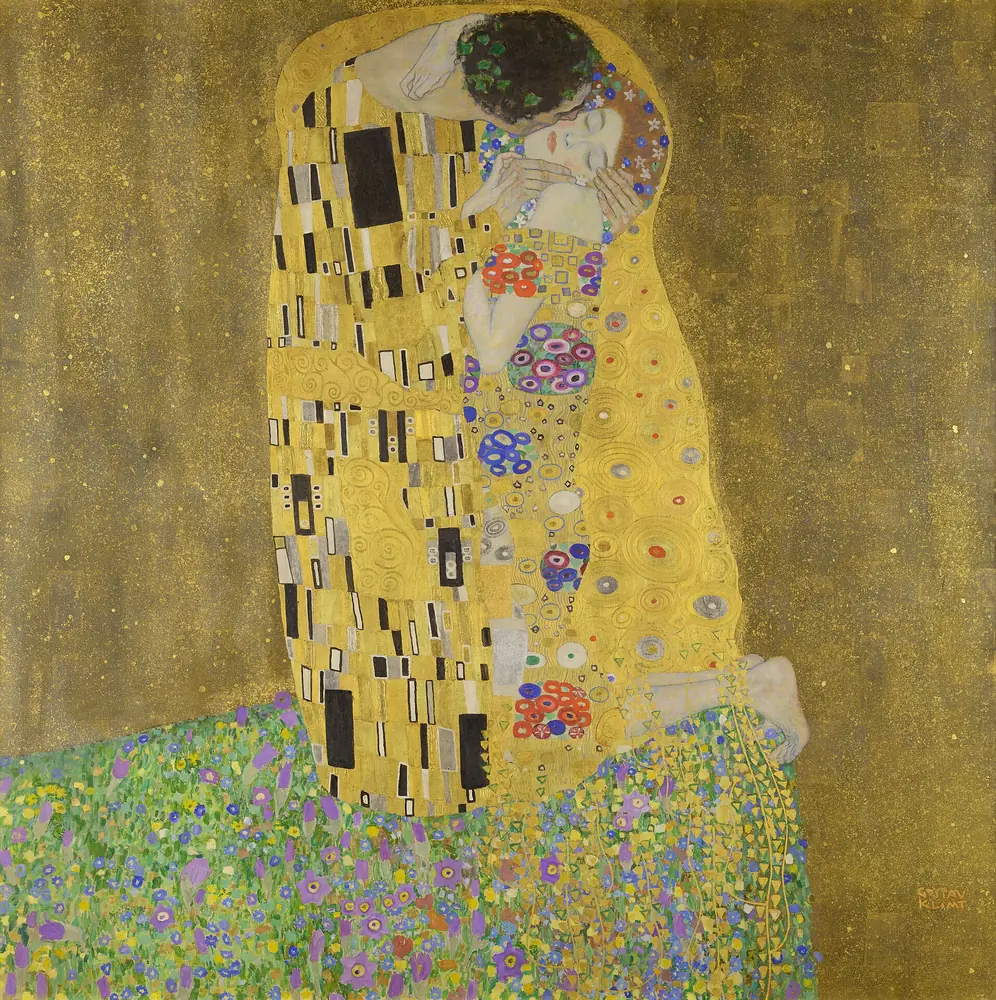
The Kiss
Painted between 1907 and 1908, The Kiss is the crowning achievement of Austrian Symbolist Gustav Klimt's celebrated Golden Period. Exhibited in 1908 under the title Liebespaar, or the lovers, the oil-on-canvas masterpiece portrays an embracing couple wrapped in luminous, ornate robes. To craft its shimmering surface, Klimt embellished the canvas with gold leaf, silver, and platinum, drawing inspiration from the curvilinear rhythms of contemporary Art Nouveau and the organic forms of the Arts and Crafts movement. The figures merge into a decorative tapestry, their physical intimacy heightened by shimmering geometric patterns. Considered the defining masterpiece of the Vienna Secession, Austria's distinctive variant of Art Nouveau, the painting hangs today in the Österreichische Galerie Belvedere in Vienna. It represents a bold synthesis of sensual emotion and decorative extravagance, standing as Klimt's most renowned and enduring contribution to modern European painting.
Look for
- The delicate application of gold leaf, silver, and platinum across the canvas.
- The entwined couple cloaked in elaborate robes with contrasting decorative patterns.
- The subtle Art Nouveau curves and organic forms of the Arts and Crafts style.
The Daily Quiz
5 questions from today's reading. Pick an answer to see if you're right.
-
Which celestial feature was named in honor of Nigerian modernist Ben Enwonwu?
Answer
A crater on Mercury. A crater on the planet Mercury was named in honor of Ben Enwonwu, celebrated as Africa's Greatest Artist.
-
Which celebrated architect designed the Guggenheim Museum Bilbao alongside the Nervion River?
Answer
Frank Gehry. The museum was designed by Canadian-American architect Frank Gehry and opened in 1997.
-
How did Indian painter Raja Ravi Varma greatly expand public access to fine art?
Answer
By producing affordable lithographs of his paintings. Varma made affordable lithographs of his paintings available to the public, increasing ordinary people's involvement with the arts.
-
What does the Japanese art term 'ukiyo-e' literally translate to?
Answer
Pictures of the floating world. The Japanese phrase ukiyo-e translates directly into English as 'picture[s] of the floating world'.
-
Which French artist was the original proponent of the 1840s Realism movement?
Answer
Gustave Courbet. Gustave Courbet was the original proponent of Realism, seeking to depict contemporary life with truth and accuracy.
Puzzle Corner
Who am I?
- In my youth, I painted romantic murals on the walls of my family's country house, Jas de Bouffan.
- Rejecting traditional academic perspective, I analyzed Impressionist expression to expose the underlying structure of physical objects.
- My revolutionary pictorial language established a vital bridge linking late nineteenth-century Impressionism to early twentieth-century Cubism.
- I was a French Post-Impressionist master who transformed modern Western art before dying in October 1906.
Reveal the answer
Paul Cézanne. Paul Cézanne was a French Post-Impressionist whose innovative structural compositions paved the way for twentieth-century modernism. Wikipedia →
Scrambled masters
GAIROGAVCA
Baroque master who pioneered tenebrism, transfixing emotional figures in dramatic shafts of light.
Show answer
Caravaggio Wikipedia →
EREN TARGIMTE
Belgian surrealist celebrated for placing everyday objects in startling, reality-bending arrangements.
Show answer
René Magritte Wikipedia →
OCASCFRIN AYGO
Aragonese romantic painter and printmaker acclaimed as the last of the Old Masters and first modern.
Show answer
Francisco Goya Wikipedia →
Word of the Day
Ink wash painting
INK wahsh PAYN-ting
A traditional Chinese monochrome brush technique that uses varied concentrations of black ink washes to capture the spirit and essence of subjects rather than direct imitation.
Example: Chinese ink wash landscape scrolls developed during the Song dynasty.
Wikipedia →Daily features are written by ArtSleuth's AI (Google Gemini) from the linked Wikipedia articles. Paintings: public domain, via Wikimedia Commons.