The ArtSleuth Chronicle
“Curated insights from the world of art.”
Today's Edition
October 1, 2026On This Day
-
1507
Born
Italian Mannerist architect Giacomo Barozzi da Vignola was born, celebrated for designing the Church of the Gesù in Rome and helping spread Renaissance style across Western Europe.
Wikipedia → -
1532
Died
Jan Mabuse, a pioneering Low Countries painter who studied in Rome and helped spearhead Romanism in Northern Renaissance art, died.
Wikipedia → -
1681
Born
Venetian Baroque painter Giulia Elisabetta Lama was born, distinguishing herself with an intense style and as one of the first women artists to study the male nude.
Wikipedia → -
2004
Died
Renowned American fashion and portrait photographer Richard Avedon died, leaving an enduring visual legacy through his dynamic work for Vogue and Harper's Bazaar.
Wikipedia →
Artwork of the Day
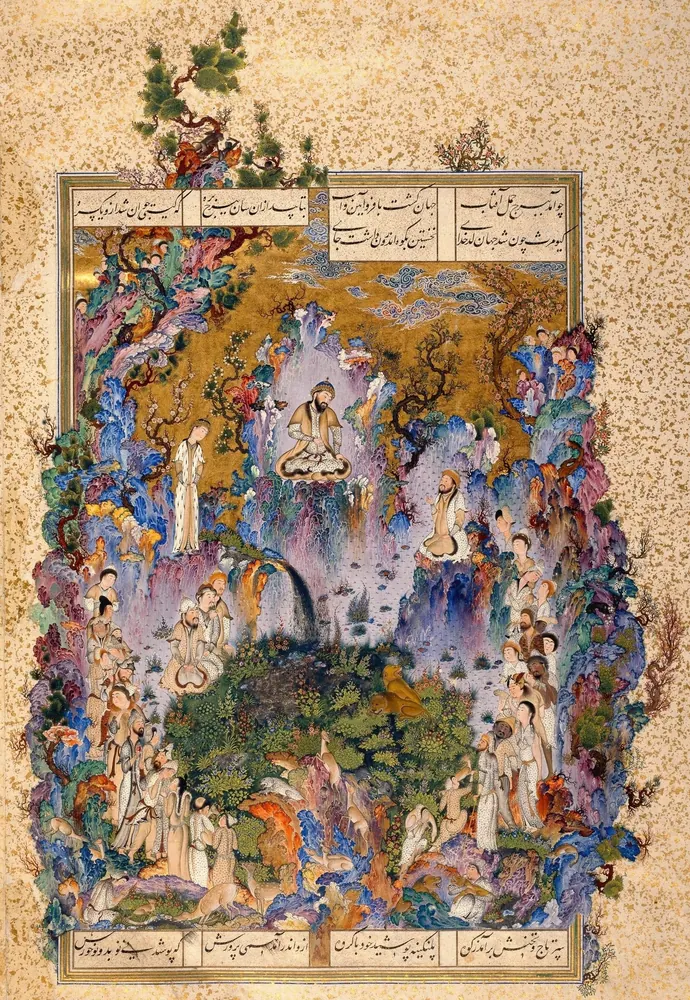
The Court of Gayumars
Painted around 1522–1525 by Sultan Muhammad, The Court of Gayumars is a masterpiece from the celebrated Shahnameh of Shah Tahmasp. Created in the imperial workshop of Tabriz during the reigns of Shah Ismail I and Shah Tahmasp I, this illuminated page depicts Gayumars, the first mythological king of Iran, presiding over his court from an idyllic mountaintop. Created as part of the national epic of Greater Iran, the manuscript represented a pinnacle of Persian miniature painting, notable for its refined Nastaʿlīq calligraphy, intricate composition, and harmonious harmony with nature. In 1568, the finished royal volume containing 258 exquisite miniatures was presented as a gift to the Ottoman Sultan Selim II. Although the manuscript was tragically broken up in the 1970s and dispersed across global collections, Sultan Muhammad's luminous vision remains one of the greatest achievements in Islamic book arts.
Look for
- The figure of King Gayumars seated serenely upon a mountaintop
- Lavish swirling rock formations blossoming into vibrant landscapes
- Courtiers and diverse wild animals gathered peacefully in harmony
The Daily Quiz
5 questions from today's reading. Pick an answer to see if you're right.
-
What purchase marked the founding of the State Hermitage Museum by Catherine the Great in 1764?
Answer
A group of paintings from Berlin merchant Johann Ernst Gotzkowsky. Catherine the Great founded the Hermitage in 1764 upon acquiring paintings from Berlin merchant Johann Ernst Gotzkowsky.
-
On what support material did Hieronymus Bosch generally execute his oil paintings?
Answer
Oak wood. Bosch's work was generally executed in oil on oak wood.
-
Which phrase is pop artist Andy Warhol credited with popularizing?
Answer
15 minutes of fame. Warhol is credited with popularizing the phrase '15 minutes of fame'.
-
How did Leonardo da Vinci describe the optical effect of the sfumato technique?
Answer
Without lines or borders, in the manner of smoke. Leonardo da Vinci characterized sfumato as 'without lines or borders, in the manner of smoke'.
-
Compared to Persian miniatures, what subject matter did Mughal painting show a much greater immediate interest in?
Answer
Realistic portraiture. Mughal painting took a much greater interest in realistic portraiture than was typical of Persian miniatures.
Puzzle Corner
Who am I?
- I was praised by contemporary biographers as the most accomplished artist of my era, leaving an extensive archive of surviving letters, sketches, and records.
- Though born in the Florentine Republic, I spent most of my creative career in Rome from my thirties onward, mastering painting, architecture, and sculpture.
- My creative rivalry with an elder contemporary, Leonardo da Vinci, cemented both of us as quintessential figures of the High Renaissance.
- Drawing deep inspiration from classical antiquity, my works defined Western art and epitomized the versatile Renaissance man.
Reveal the answer
Michelangelo. I am Michelangelo, the legendary Italian sculptor, painter, and architect of the High Renaissance. Wikipedia →
Scrambled masters
UPLA ELKE
Bauhaus teacher known for his color theory lectures and whimsical, musical modern art.
Show answer
Paul Klee Wikipedia →
ALADOVSR DAIL
Spanish Surrealist famous for bizarre imagery, precise draftsmanship, and melting clocks.
Show answer
Salvador Dalí Wikipedia →
RBDTEMNAR
Dutch Golden Age master celebrated for hundreds of portraits, etchings, and biblical scenes.
Show answer
Rembrandt Wikipedia →
Word of the Day
Craquelure
krak-LOOR
A fine network of small cracks appearing across the surface of a painting, ivory piece, or ceramic glaze, caused by aging, drying, or intentional design.
Example: Chinese Ge ware ceramics, famous for deliberate fine crackle across their glazes.
Wikipedia →Daily features are written by ArtSleuth's AI (Google Gemini) from the linked Wikipedia articles. Paintings: public domain, via Wikimedia Commons.