The ArtSleuth Chronicle
“Curated insights from the world of art.”
Edition of November 17, 2026
On This Day
-
1780
Died
Bernardo Bellotto died, remembered as an Italian vedutista whose precise, somberly lit urban vistas preserved panoramic views of major European cities.
Wikipedia → -
1904
Born
Isamu Noguchi was born, beginning a multifaceted career across public sculpture, landscape architecture, stage design, and celebrated Akari light sculptures.
Wikipedia → -
1917
Died
Auguste Rodin died, leaving behind a radical legacy as a founder of modern sculpture renowned for expressive, physical masterworks like The Thinker and The Kiss.
Wikipedia → -
1940
Event
Tartu Art Museum was established in Estonia by members of the Pallas art school, growing into the largest art museum in Southern Estonia.
Wikipedia →
Artwork of the Day
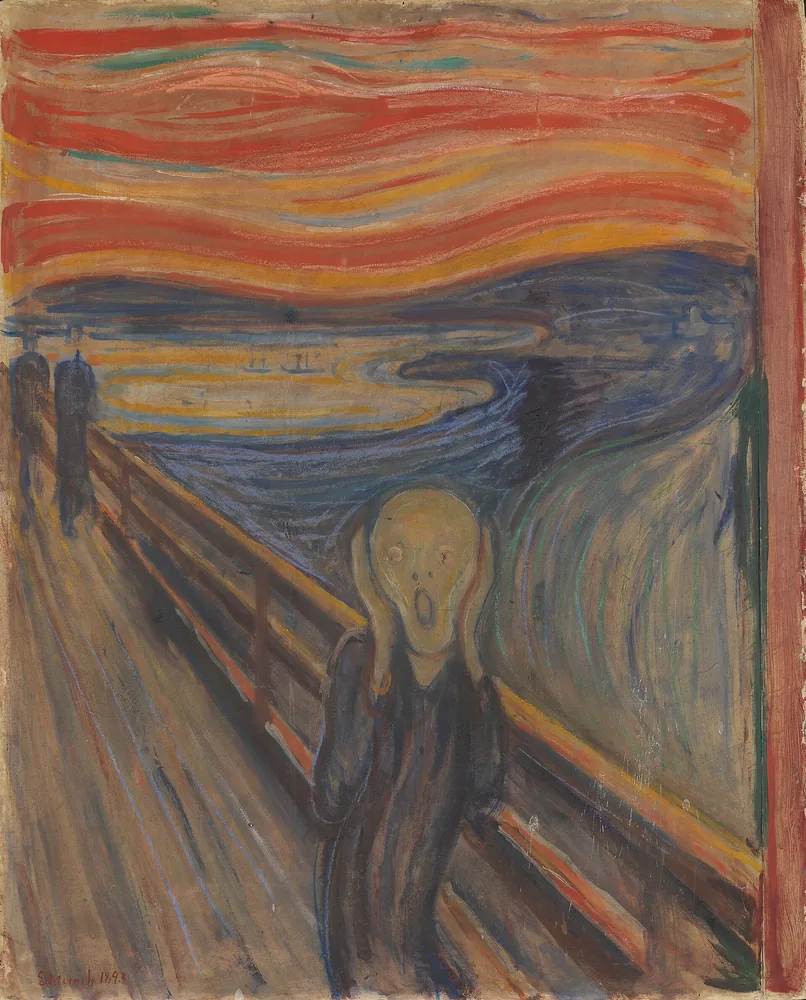
The Scream
Created in 1893 by Norwegian artist Edvard Munch, The Scream depicts an agonized figure clutching its face against a swirling, tumultuous landscape. Munch recounted that while walking along a fjord path near Oslo at sunset, the sky abruptly turned blood red, evoking the sensation of an infinite scream passing through nature. Scholars have linked this striking imagery to diverse influences, from atmospheric optical effects caused by a distant volcanic eruption to Munch's personal emotional distress regarding his sister's commitment to a nearby asylum. Rather than depicting an objective scene, Munch translated intense psychological turmoil into visual form, using undulating lines and fiery colors to capture universal existential dread. As one of art history's most iconic and haunting images, The Scream played a foundational role in shaping the modern Expressionist movement.
Look for
- The swirling, blood-red sky above the fjord
- Two distant figures walking along the straight railing
- The central figure clutching its head in dread
The Daily Quiz
5 questions from today's reading. Pick an answer to see if you're right.
-
Which institution actively encouraged the Baroque style to counter the simplicity of Protestant art?
Answer
The Catholic Church. The Catholic Church encouraged Baroque art and architecture as an emotive counter to Protestant austerity.
-
Which artist is the single most extensively represented painter in the Museo del Prado's collection?
Answer
Francisco Goya. Francisco Goya is the single most extensively represented artist in the Prado collection.
-
Which Spanish monarch employed Diego Velázquez as his leading court painter?
Answer
Philip IV. Diego Velázquez served as the leading artist in the court of King Philip IV of Spain and Portugal.
-
What is a defining characteristic of the impasto painting technique?
Answer
Laying paint on thickly so strokes remain visible. Impasto involves applying paint thickly enough that brush or palette knife marks remain clearly visible and textural.
-
Which instructional text originally sparked Qi Baishi's self-taught journey into painting?
Answer
The Mustard Seed Garden Manual. Qi Baishi taught himself to paint after being inspired by the Manual of the Mustard Seed Garden.
Puzzle Corner
Who am I?
- My extensive notebooks recorded pioneering observations across anatomy, cartography, paleontology, and optics.
- Trained in Florence under Andrea del Verrocchio, I was celebrated across Europe as a versatile polymath.
- I famously described my signature blending technique as rendering subjects without lines, in the manner of smoke.
- My portrait of the Florentine noblewoman Mona Lisa stands as one of the defining masterpieces of the High Renaissance.
Reveal the answer
Leonardo da Vinci. I am Leonardo da Vinci, the quintessential Renaissance polymath whose artistry and scientific inquiries shaped Western civilization. Wikipedia →
Scrambled masters
HOSIRHEIG
Master of Japanese ukiyo-e woodblock prints known for the Fifty-three Stations of the Tōkaidō landscape series.
Show answer
Hiroshige Wikipedia →
JSOANHEN EEERMVR
Dutch Golden Age painter from Delft celebrated for intimate, meticulously composed interior domestic scenes.
Show answer
Johannes Vermeer Wikipedia →
ODGIE RAREVI
Prominent Mexican painter whose sweeping public frescoes established the international muralist movement.
Show answer
Diego Rivera Wikipedia →
Daily features are written by ArtSleuth's AI (Google Gemini) from the linked Wikipedia articles. Paintings: public domain, via Wikimedia Commons.