The ArtSleuth Chronicle
“Curated insights from the world of art.”
Edition of November 9, 2026
On This Day
-
1677
Died
Dutch Golden Age painter Aert van der Neer died, remembered for delicate night scenes lit by moonlight and fires.
Wikipedia → -
1778
Died
Italian artist Giovanni Battista Piranesi died, celebrated for his etchings of Rome and atmospheric fantasy prisons.
Wikipedia → -
1853
Born
Architect Stanford White was born, later shaping the American Renaissance as a partner in McKim, Mead & White.
Wikipedia → -
1911
Died
Illustrator Howard Pyle died, leaving a lasting legacy through his teaching and the founding of his illustration school.
Wikipedia →
Artwork of the Day
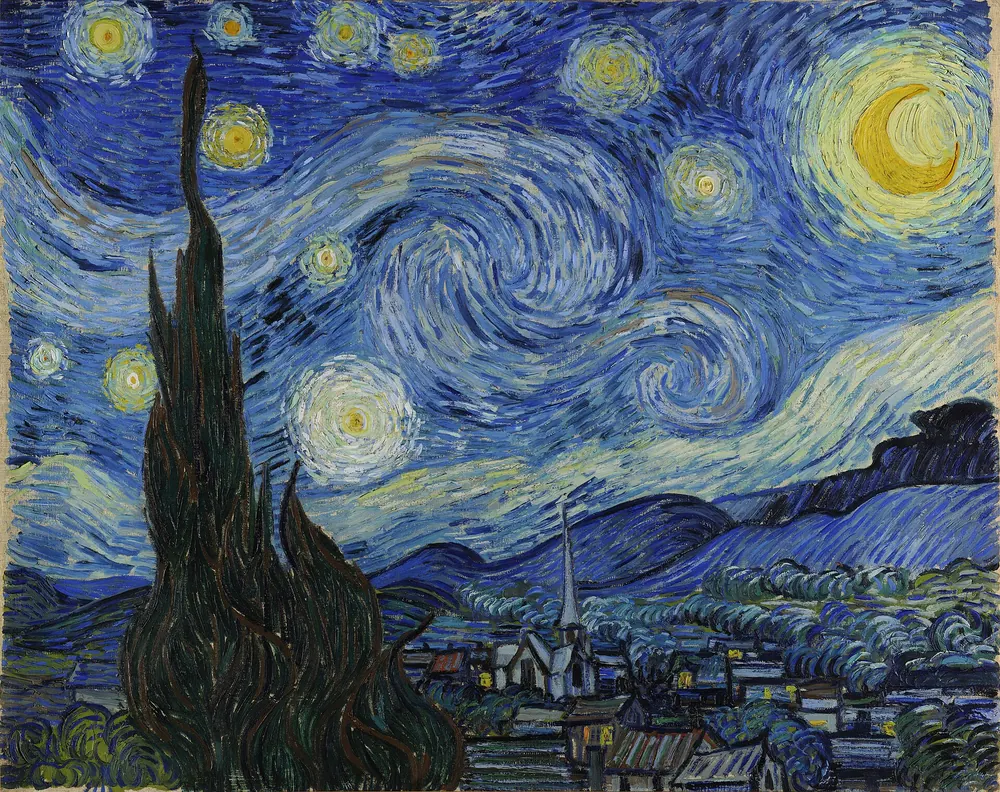
The Starry Night
Painted in mid-June 1889, The Starry Night is an oil-on-canvas masterpiece by Dutch Post-Impressionist Vincent van Gogh. The artist created the work while residing at the Saint-Paul-de-Mausole mental asylum near Saint-Rémy-de-Provence, where he had voluntarily admitted himself in May following a severe breakdown. The composition captures the view from his east-facing asylum bedroom window just before sunrise, blended with an idealized, imaginary village nestled beneath the turbulent sky. Van Gogh channels profound emotion through expressive brushwork and luminous hues, turning a nocturnal landscape into a deeply personal vision. Recognized as a touchstone of modern art, the canvas has been in the permanent collection of the Museum of Modern Art in New York City since 1941, having entered the institution through the Lillie P. Bliss Bequest. It remains one of the most famous and recognizable images in the Western artistic canon.
Look for
- The imaginary village nestled beneath the hills
- The pre-dawn light outside his east-facing window
- The swirling, expressive brushwork across the sky
The Daily Quiz
5 questions from today's reading. Pick an answer to see if you're right.
-
Which celebrated painting by Tarsila do Amaral inspired Oswald de Andrade's Manifesto Antropófago?
Answer
Abaporu. Tarsila do Amaral's painting Abaporu directly inspired Oswald de Andrade's famous Manifesto Antropófago.
-
Which movement arose at the end of the 18th century as a response to the Enlightenment and Industrial Revolution?
Answer
Romanticism. Romanticism championed subjectivity, imagination, and nature in response to the Enlightenment and the Industrial Revolution.
-
During which Chinese dynasty did monochrome ink wash painting first emerge?
Answer
Tang dynasty. Ink wash painting emerged in China during the Tang dynasty, overturning earlier, more realistic painting techniques.
-
In which country did Paul Gauguin spend part of his childhood between 1850 and age six?
Answer
Peru. Gauguin's family settled in Peru in 1850, where he enjoyed a privileged childhood that left a lasting impression.
-
Who designed the current main building of the Rijksmuseum that opened in 1885?
Answer
Pierre Cuypers. The Rijksmuseum's main building at Museum Square was designed by architect Pierre Cuypers.
Puzzle Corner
Who am I?
- Born in the Pale of Settlement near Vitebsk, I drew early inspiration from Eastern European and Jewish folklore.
- Associated with the École de Paris, my versatile practice encompassed stained glass, tapestries, sets, and prints.
- Before the First World War, I developed my modernist visual language while traveling between Saint Petersburg, Paris, and Berlin.
- During the wartime years, I worked in Vitebsk and Petrograd, rising to become one of Russia's most distinguished modernist artists.
Reveal the answer
Marc Chagall. Marc Chagall was a pioneering modernist renowned for his poetic dreamscapes rooted in Jewish folklore. Wikipedia →
Scrambled masters
NEB WNOUWNE
Celebrated Nigerian modernist painter and sculptor who has a crater on Mercury named in his honor.
Show answer
Ben Enwonwu Wikipedia →
LUAP CZNEAEN
French Post-Impressionist whose structural compositions bridged 19th-century Impressionism and Cubism.
Show answer
Paul Cézanne Wikipedia →
SUGTVA IMKTL
Austrian Vienna Secession painter famous for his erotic female figures and gilded masterworks like The Kiss.
Show answer
Gustav Klimt Wikipedia →
Word of the Day
Fresco
FRESS-koh
A technique of mural painting executed on freshly laid, wet lime plaster. As the plaster sets, dry pigments mixed with water bind chemically into the surface, integrating the painting directly into the wall.
Example: The Sistine Chapel ceiling
Wikipedia →Daily features are written by ArtSleuth's AI (Google Gemini) from the linked Wikipedia articles. Paintings: public domain, via Wikimedia Commons.