The ArtSleuth Chronicle
“Curated insights from the world of art.”
Edition of November 5, 2026
On This Day
-
1559
Died
Japanese painter Kanō Motonobu organized the Kanō school, building an influential system that trained the vast majority of painters across the Edo period.
Wikipedia → -
1807
Died
Swiss painter Angelica Kauffman was a celebrated history painter and one of only two female founding members of the Royal Academy of Art in London.
Wikipedia → -
1926
Born
English critic and painter John Berger wrote the Booker Prize-winning novel G. and the culturally influential art text and BBC series Ways of Seeing.
Wikipedia → -
1946
Died
Italian-born American Futurist Joseph Stella became renowned for his dynamic paintings of industrial America, notably his series on the Brooklyn Bridge.
Wikipedia →
Artwork of the Day
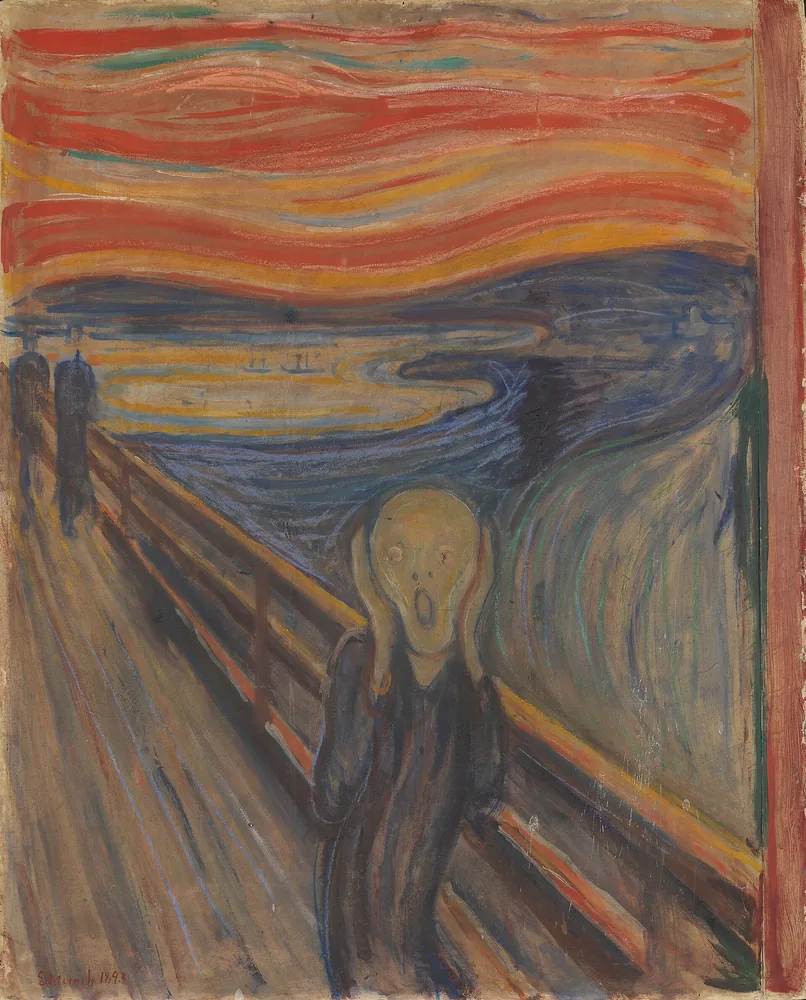
The Scream
The Scream, created by Norwegian artist Edvard Munch in 1893, centers on an agonized figure clutching its face beneath an unnaturally swirling, fiery sky. Munch found inspiration while walking along a fjord path overlooking Oslo at sunset, when the clouds suddenly turned blood red and he sensed an infinite scream passing through nature. Scholars have suggested the striking orange sky might reflect the atmospheric effects of a volcanic eruption or Munch's psychological reaction to his sister's involuntary commitment at a nearby lunatic asylum. Rather than presenting a literal landscape, Munch rendered an internal emotional crisis, capturing profound existential dread linked to the human condition. This stark visualization of psychological distress exerted a formative influence on the Expressionist movement and remains one of the most recognizable masterworks in art history.
Look for
- The blood-red, swirling sunset sky
- The agonized figure holding its head
- The long straight railing beside the fjord path
The Daily Quiz
5 questions from today's reading. Pick an answer to see if you're right.
-
What technique is Jackson Pollock celebrated for using to paint from all angles on a horizontal surface?
Answer
Drip technique. Pollock poured and splashed liquid household paint onto canvases using his drip technique to execute his action paintings.
-
Which publication inspired Qi Baishi to teach himself how to paint?
Answer
Manual of the Mustard Seed Garden. Qi Baishi taught himself painting after being sparked by the Manual of the Mustard Seed Garden.
-
What moral outlook did European Romanticists embrace over the social conventions of their era?
Answer
Individualism. Romanticists rejected contemporary social conventions in favor of individualism, prioritizing passion, intuition, and imagination.
-
In which Tokyo park is the Tokyo National Museum located?
Answer
Ueno Park. The Tokyo National Museum is located within Ueno Park in the Taitō ward of Tokyo.
-
Which substance is traditionally used as a binding agent in gouache paint?
Answer
Gum arabic or dextrin. Gouache consists of natural pigment, water, and a binding agent such as gum arabic or dextrin.
Puzzle Corner
Who am I?
- Born to working-class Rusyn immigrant parents in Pittsburgh, I began my career in New York as a commercial artist.
- I became a prominent leader of pop art by exploring consumerism, mass media, and advertising through mechanical reproduction.
- My practice crossed multiple formats beyond painting, encompassing filmmaking, photography, publishing, and performance art.
- I popularized the famous cultural phrase predicting that everyone would enjoy fifteen minutes of fame.
Reveal the answer
Andy Warhol. I am Andy Warhol, the American pop art pioneer renowned for transforming consumer culture and celebrity imagery into fine art. Wikipedia →
Scrambled masters
UPAL AENCZEN
Post-Impressionist master whose structural approach bridged nineteenth-century Impressionism and early Cubism.
Show answer
Paul Cézanne Wikipedia →
CRMA CLLAHAG
Modernist artist from Vitebsk who blended Eastern European and Jewish folklore into paintings, stained glass, and sets.
Show answer
Marc Chagall Wikipedia →
IYAL IPENR
Russian realist renowned for Barge Haulers on the Volga and insightful portraits of figures such as Leo Tolstoy.
Show answer
Ilya Repin Wikipedia →
Word of the Day
Sfumato
sfoo-MAH-toh
A painting technique for softening the transition between colors to mimic an out-of-focus plane without sharp lines or borders.
Example: Leonardo da Vinci famously implemented sfumato in his portrait of the Mona Lisa.
Wikipedia →Daily features are written by ArtSleuth's AI (Google Gemini) from the linked Wikipedia articles. Paintings: public domain, via Wikimedia Commons.