The ArtSleuth Chronicle
“Curated insights from the world of art.”
Today's Edition
October 25, 2026On This Day
-
1802
Born
English Romantic landscape painter Richard Parkes Bonington was born, renowned for bringing English stylistic approaches to France.
Wikipedia → -
1881
Born
Pablo Picasso, one of the 20th century's most influential artists and co-founder of Cubism, was born in Spain.
Wikipedia → -
1894
Born
French surrealist photographer, sculptor, and writer Claude Cahun was born, celebrated for exploratory self-portraits and staged personae.
Wikipedia → -
1916
Died
American Impressionist painter William Merritt Chase, who founded the Chase School (later the Parsons School of Design), died.
Wikipedia →
Artwork of the Day
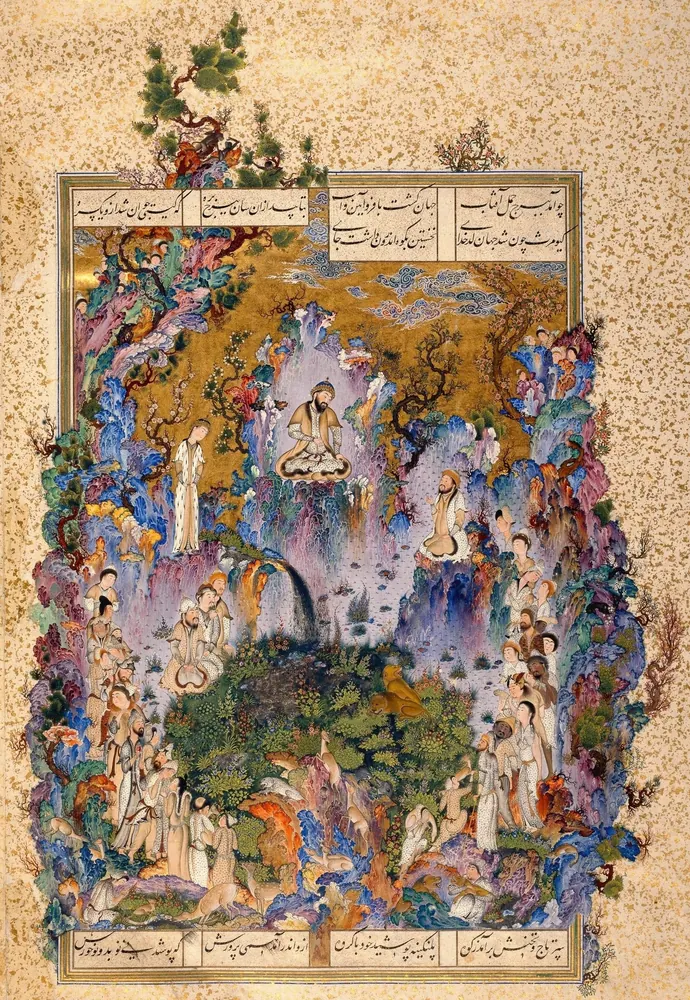
The Court of Gayumars
Painted around 1522–1525 by Sultan Muhammad, "The Court of Gayumars" is a celebrated Persian miniature from the Shahnameh of Shah Tahmasp. Created in the imperial workshop in Tabriz during the reigns of Shah Ismail I and Shah Tahmasp I, this manuscript illustrated the national epic of Greater Iran with 258 exquisite miniatures among 759 pages. It captures Gayumars, the first mythical king of Iran, presiding over his court in a lush, harmonious mountain landscape where humans and wild beasts coexist peacefully. Rendered on pages measuring approximately 48 by 32 centimeters, the composition demonstrates the height of Safavid miniature painting, distinguished by swirling rock formations, delicate flora, and refined calligraphy in elegant Nastaʿlīq script. In 1568, the manuscript was gifted to the Ottoman Sultan Selim II before being broken up and dispersed to worldwide collections during the 1970s.
Look for
- Gayumars enthroned high amid vibrant, otherworldly rock formations.
- Courtiers and gentle animals gathering peacefully in harmony below.
- Fine Persian verses penned above and below in graceful Nastaʿlīq script.
The Daily Quiz
5 questions from today's reading. Pick an answer to see if you're right.
-
What primary wax ingredient is most commonly combined with damar resin in encaustic painting?
Answer
Beeswax. Encaustic recipes most commonly consist of beeswax and damar resin blended with pigments.
-
Against which established style did Rococo emerge as a reaction in 1730s France?
Answer
The Louis XIV style. Rococo emerged in France during the 1730s specifically as a reaction against the Louis XIV style.
-
Where did Caspar David Friedrich study from 1794 to 1798 before establishing himself in Dresden?
Answer
Copenhagen. Friedrich was born in Greifswald and studied in Copenhagen from 1794 to 1798 before settling in Dresden.
-
Which artist is the single most extensively represented in the Museo del Prado's collection?
Answer
Francisco Goya. Francisco Goya is noted as the single most extensively represented artist in the Prado's holdings.
-
In which country did Paul Gauguin spend a privileged childhood until the age of six?
Answer
Peru. Gauguin's family settled in Peru in 1850, where he lived a privileged childhood until age six before returning to France.
Puzzle Corner
Who am I?
- I was taken under the wing of Gustav Klimt, who served as a vital mentor in my early career.
- My work stood at the forefront of early Expressionism, known for twisted body shapes and intensely expressive lines.
- I unflinchingly turned the mirror upon myself, creating numerous raw, direct, and often nude self-portraits.
- My brief life unfolded in Austria, where my art explored psychological intensity and provocative sexuality.
Reveal the answer
Egon Schiele. Egon Schiele was a groundbreaking Austrian Expressionist painter known for his sharp draftsmanship and intense self-portraits. Wikipedia →
Scrambled masters
YDNA LARHWO
Pop art leader who explored celebrity and consumer culture and popularized '15 minutes of fame'.
Show answer
Andy Warhol Wikipedia →
TRAELCHB RRUED
Nuremberg master of the German Renaissance celebrated across Europe for woodcuts and engravings.
Show answer
Albrecht Dürer Wikipedia →
AAITKAWG UAOTAMR
Ukiyo-e master acclaimed for his delicate 1790s large-headed portraits of beautiful women.
Show answer
Kitagawa Utamaro Wikipedia →
Word of the Day
Sfumato
sfoo-MAH-toh
A painting method that softens the transitions between colors and tones, mimicking an out-of-focus plane without sharp lines or borders.
Example: Mona Lisa by Leonardo da Vinci
Wikipedia →Daily features are written by ArtSleuth's AI (Google Gemini) from the linked Wikipedia articles. Paintings: public domain, via Wikimedia Commons.