The ArtSleuth Chronicle
“Curated insights from the world of art.”
Today's Edition
October 24, 2026On This Day
-
1830
Born
English botanical artist Marianne North was born; she became renowned for her extensive foreign travels, vibrant plant paintings, and the gallery she established at Kew Gardens.
Wikipedia → -
1898
Died
Prominent French mural painter Pierre Puvis de Chavannes died, leaving a revered legacy as a co-founder and president of the Société Nationale des Beaux-Arts.
Wikipedia → -
1899
Born
Japanese photographer Teikō Shiotani was born; he became a major figure in Japanese pictorialism by capturing regional landscapes and experimenting with optical aberrations.
Wikipedia → -
1938
Died
German expressionist sculptor Ernst Barlach died; he was widely celebrated for his powerful anti-war sculptures, which the Nazi Party later confiscated as degenerate art.
Wikipedia →
Artwork of the Day
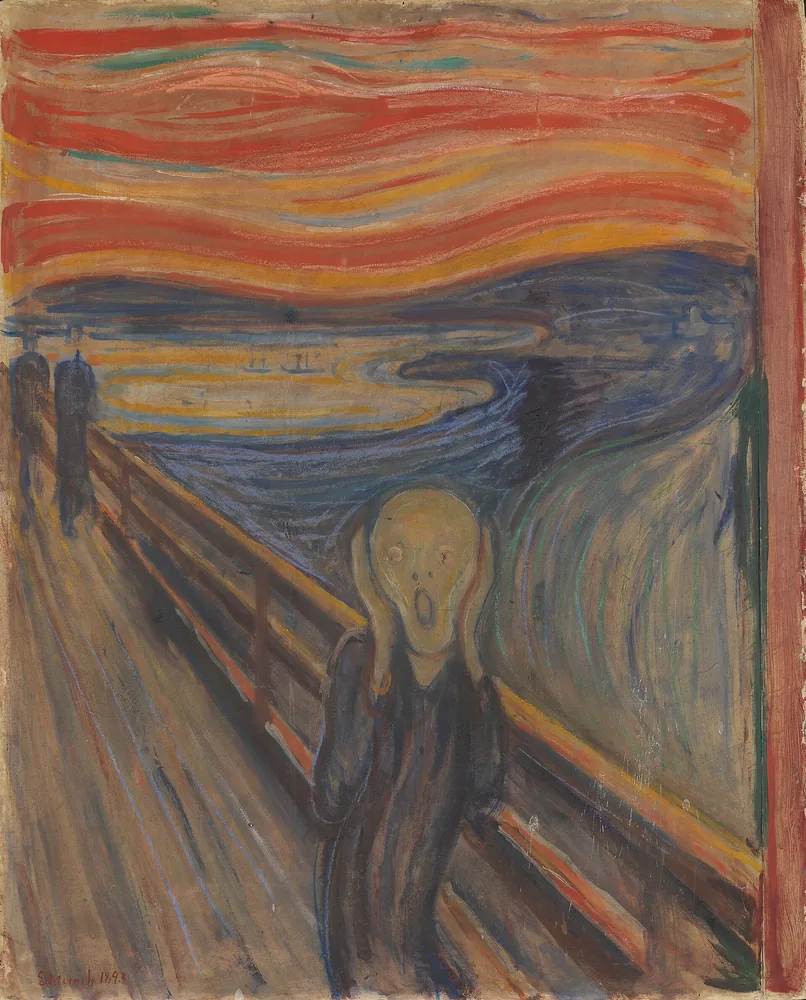
The Scream
Created in 1893 by Norwegian painter Edvard Munch, The Scream is among the most recognized images in art history, serving as an enduring symbol of existential dread and the fragile human condition. Munch was inspired during an evening walk along a fjord path overlooking Oslo. As the setting sun abruptly turned the clouds a fiery blood-red, he sensed what he described as an infinite scream passing through nature. This intense psychological experience translated directly onto the canvas through swirling, sinuous brushwork and vivid, unnatural colors. Scholars have debated whether the intense sky mirrored atmospheric anomalies from a distant volcanic eruption or Munch's inner emotional turmoil concerning his sister's institutionalization at a nearby asylum. Regardless of its origin, the masterpiece broke away from descriptive realism to prioritize raw, subjective sensation, exercising a foundational and permanent influence on the development of the modern Expressionist movement.
Look for
- The swirling, unnatural blood-red and orange sky above the fjord
- The gaunt, pale central figure clutching its face in distress
- Two distant, upright figures walking calmly along the bridge railing
The Daily Quiz
5 questions from today's reading. Pick an answer to see if you're right.
-
Which artist founded the abstract movement Suprematism in 1913?
Answer
Kazimir Malevich. Kazimir Malevich founded Suprematism in 1913, focusing on fundamental geometric shapes and pure artistic feeling.
-
Which Florentine master provided art and sculpture education to Leonardo da Vinci?
Answer
Andrea del Verrocchio. Leonardo da Vinci began his training in Florence under the guidance of painter and sculptor Andrea del Verrocchio.
-
At which institution did Paul Klee teach alongside his colleague Wassily Kandinsky?
Answer
Bauhaus. Paul Klee and Wassily Kandinsky both taught at the Bauhaus school of art, design and architecture in Germany.
-
Which French monarch converted the Louvre fortress into a primary royal residence in 1546?
Answer
Francis I. Francis I turned the medieval fortress into the main residence of French kings in 1546.
-
What core method defines the decorative technique of sgraffito?
Answer
Scratching through a surface coating to reveal a contrasting layer. Sgraffito involves scratching through an outer coating on plaster or pottery to show an underlying contrasting color.
Puzzle Corner
Who am I?
- I rejected the classical models of Greece and Rome, preferring to journey across North Africa in search of the exotic.
- My vivid use of color and dramatic motion drew inspiration from Rubens and Venetian masters rather than the linear precision of my rival Ingres.
- A kindred spirit to Théodore Géricault, I found deep resonance with Lord Byron's vision of the violent, sublime forces of nature.
- As a nineteenth-century French painter, I came to be celebrated as the acknowledged leader of the Romantic school.
Reveal the answer
Eugène Delacroix. You are Eugène Delacroix, the master of French Romanticism famed for his vibrant palette and passionate compositions. Wikipedia →
Scrambled masters
CLATBHRE EUDRR
German Renaissance printmaker renowned for his masterful woodcuts and engravings patronized by Emperor Maximilian I.
Show answer
Albrecht Dürer Wikipedia →
HNJO EAOTNSLBC
English Romantic landscape painter famous for portraying Dedham Vale and rural scenes such as The Hay Wain.
Show answer
John Constable Wikipedia →
INOERYUMSH BCOSH
Early Netherlandish painter who created fantastic, nightmarish depictions of religious themes on oak panels.
Show answer
Hieronymus Bosch Wikipedia →
Word of the Day
Foreshortening
for-SHOR-tuh-ning
An optical effect in linear perspective where an object's dimensions appear compressed along the line of sight relative to its width.
Example: Andrea Mantegna's 'Lamentation of Christ'
Wikipedia →Daily features are written by ArtSleuth's AI (Google Gemini) from the linked Wikipedia articles. Paintings: public domain, via Wikimedia Commons.