The ArtSleuth Chronicle
“Curated insights from the world of art.”
Edition of October 15, 2026
On This Day
-
1690
Died
Spanish Baroque painter and etcher Juan de Valdés Leal passed away, concluding an influential career in seventeenth-century Spanish art.
Wikipedia → -
1836
Born
French artist James Tissot was born, known for his depictions of high society and Victorian fashion, caricatures for Vanity Fair, and diverse genre scenes.
Wikipedia → -
1938
Born
American painter Brice Marden was born, celebrated for minimalist art with foundations in abstract expressionism, color field painting, and lyrical abstraction.
Wikipedia → -
1968
Died
American author and illustrator Virginia Lee Burton died, leaving behind beloved illustrated books and the influential Folly Cove Designers textile collective.
Wikipedia →
Artwork of the Day
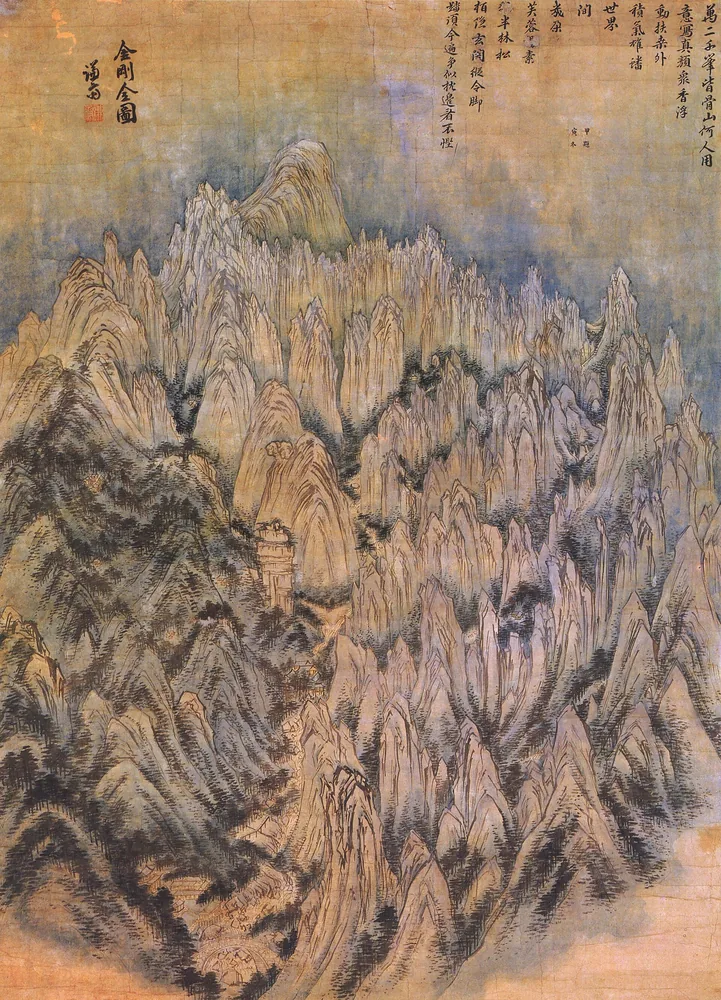
General View of the Diamond Mountains
Created in 1734 during the reign of King Yeongjo, General View of the Diamond Mountains (known in Korean as Geumgang jeondo) is a celebrated landscape masterpiece by the Korean painter Jeong Seon. The painting renders a panoramic, bird's-eye perspective of Mount Geumgangsan, famed as the Diamond Mountains. In producing this work, Jeong Seon captured the rugged, majestic peaks and natural splendour of the revered Korean site, demonstrating an innovative approach to landscape representation that departed from conventional Chinese landscape formulas. Over time, the composition became iconic within Korean art history. On August 6, 1984, the painting was officially recognized as the 217th National Treasure of South Korea. Today, this renowned cultural treasure is held and managed by the Ho-Am Art Museum in Yongin, Gyeonggi Province, and is owned by Lee Kun-hee.
Look for
- The sweeping panoramic perspective of Mount Geumgangsan
- The distinctive rendering of the Diamond Mountains' rocky peaks
- The delicate brushwork and ink tones characteristic of eighteenth-century Korean painting
The Daily Quiz
5 questions from today's reading. Pick an answer to see if you're right.
-
Which visual motif became the defining characteristic of Wifredo Lam's unique style?
Answer
Hybrid figures. Lam's style was ultimately characterized by the prominence of hybrid figures that merged Afro-Cuban spirit with modern influences.
-
Which aesthetic movement influenced the vision of the Hudson River School landscape painters?
Answer
Romanticism. The mid-nineteenth-century American landscape painters of the Hudson River School were influenced by Romanticism.
-
Which celebrated painting by Tarsila do Amaral inspired Oswald de Andrade's famous Manifesto Antropófago?
Answer
Abaporu. Tarsila do Amaral's painting Abaporu inspired Oswald de Andrade to write the Manifesto Antropófago.
-
The English term 'still life' is derived from a word in which language?
Answer
Dutch. The term derives from the Dutch word 'stilleven', emerging alongside Netherlandish painting in the sixteenth and seventeenth centuries.
-
Which French monarch converted the Louvre fortress into the primary residence of the French kings in 1546?
Answer
Francis I. Francis I turned the former medieval fortress into the main royal residence in 1546.
Puzzle Corner
Who am I?
- My lecture notes on form and design theory are held to be as significant for modern art as Leonardo's treatise was for the Renaissance.
- I taught alongside my friend and colleague Wassily Kandinsky at the famous Bauhaus school in Germany.
- A natural draftsman, I explored color theory deeply, infusing my work with musicality and dry humor.
- My Swiss-born German art was shaped by expressionism, cubism, and surrealism, often adopting a childlike viewpoint.
Reveal the answer
Paul Klee. You are Paul Klee, the visionary modernist master and theorist. Wikipedia →
Scrambled masters
NIATTI
Renowned Venetian Renaissance painter celebrated for his revolutionary use of colour across portraits and mythologies.
Show answer
Titian Wikipedia →
GOEN SHEELIC
Austrian Expressionist painter mentored by Gustav Klimt, known for intense lines and expressive self-portraits.
Show answer
Egon Schiele Wikipedia →
KUOISHA
Edo-period Japanese ukiyo-e master who created the iconic print series Thirty-Six Views of Mount Fuji.
Show answer
Hokusai Wikipedia →
Word of the Day
Trompe-l'œil
tromp-LOY
An artistic technique that creates a realistic optical illusion of three-dimensional space and objects on a two-dimensional surface. It tricks the viewer into perceiving painted elements as genuine, physical objects.
Example: Painted architectural murals with simulated columns and open skies that deceive the viewer's eye.
Wikipedia →Daily features are written by ArtSleuth's AI (Google Gemini) from the linked Wikipedia articles. Paintings: public domain, via Wikimedia Commons.