The ArtSleuth Chronicle
“Curated insights from the world of art.”
Edition of October 9, 2026
On This Day
-
1840
Born
English Pre-Raphaelite painter Simeon Solomon was born, celebrated for depicting Jewish life and same-sex desire.
Wikipedia → -
1874
Born
Russian painter, writer, and archaeologist Nicholas Roerich was born; he created an immense body of over 7,000 paintings.
Wikipedia → -
1911
Born
American photographer Joe Rosenthal was born; he earned the Pulitzer Prize for his iconic photograph Raising the Flag on Iwo Jima.
Wikipedia → -
1939
Born
English modernist architect Sir Nicholas Grimshaw was born; he designed the Eden Project and served as president of the Royal Academy.
Wikipedia →
Artwork of the Day
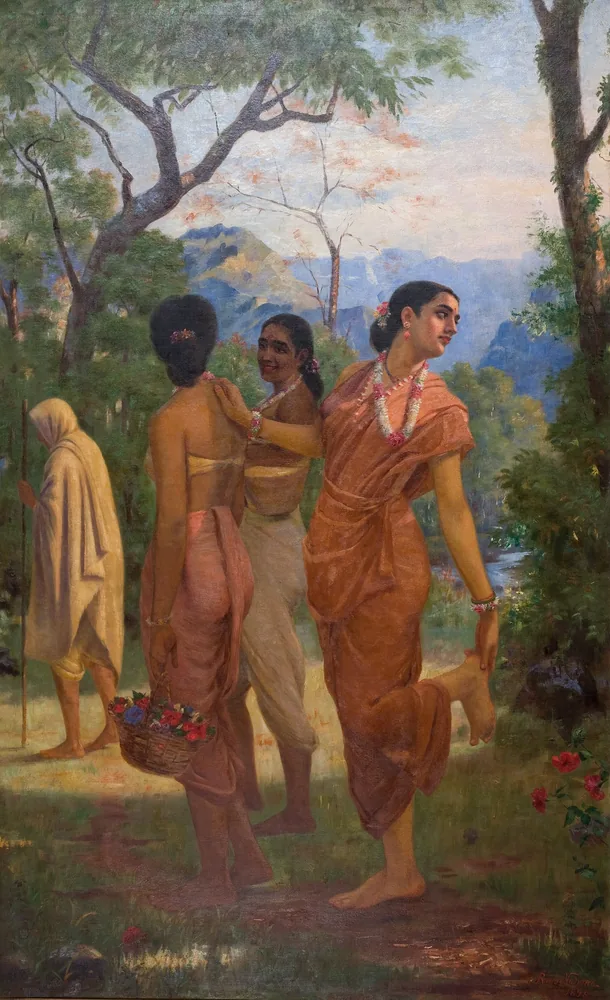
Shakuntala
Painted in 1898 by Indian artist Raja Ravi Varma, Shakuntala—also known as Shakuntala looking for Dushyanta—captures a dramatic narrative moment from the epic Mahabharata. The painting depicts Shakuntala pausing as though to remove a thorn from her foot, when she is actually twisting around to catch sight of her lover and husband, Dushyanta. Meanwhile, her companions tease her and call her bluff. Art historian Tapati Guha-Thakurta observed that this twist of head and body invites viewers directly into the ongoing story, freezing an emotional tableau like a film still. Ravi Varma's work exemplifies the powerful presence of the absent male lover who serves as the central focal point of her desire, capturing an intimate and timeless scene of romance, longing, and subtle playfulness.
Look for
- The twist and turn of Shakuntala's head and body as she looks back
- Her feigned gesture of removing a thorn from her foot
- The teasing companions who call her bluff
The Daily Quiz
5 questions from today's reading. Pick an answer to see if you're right.
-
Which artistic movement was Gustav Klimt a founding member of?
Answer
Vienna Secession. Gustav Klimt was an Austrian symbolist painter and a founding member of the Vienna Secession movement.
-
What is an object called when it is only gilded over part of its surface?
Answer
Parcel-gilt. Parcel-gilt objects are partially gilded, leaving other areas ungilted.
-
Whose negotiated agreement ensured that the Medici art collections stayed in Florence?
Answer
Anna Maria Luisa. Anna Maria Luisa, the last Medici heiress, negotiated the family pact that bequeathed the collections to Florence.
-
How do Cubist painters approach their subjects?
Answer
By depicting subjects from multiple perspectives in abstract form. Cubist artists analyze, break up, and reassemble subjects from multiple perspectives in an abstract form.
-
Which painting by Frida Kahlo achieved a record auction price of $54.7 million?
Answer
The Dream (The Bed). Her 1940 self-portrait The Dream (The Bed) achieved an auction record of $54.7 million.
Puzzle Corner
Who am I?
- In the final four years of my life, I moved constantly between Naples, Malta, and Sicily.
- I began my artistic apprenticeship in Milan in 1584 before spending a major part of my working life in Rome.
- My revolutionary painting method transfixed subjects in bright shafts of light against darkening shadows, establishing tenebrism.
- Critics recognized my style for pairing emotional and physical realism with dramatic chiaroscuro that shaped Baroque art.
Reveal the answer
Caravaggio. You are the Italian Baroque painter Caravaggio. Wikipedia →
Scrambled masters
IEDWRFO MAL
Cuban artist celebrated for hybrid figures that revived and portrayed Afro-Cuban spirit and culture.
Show answer
Wifredo Lam Wikipedia →
EGODI ZAQEVLZEU
Spanish Golden Age court painter to King Philip IV whose celebrated masterpiece is Las Meninas.
Show answer
Diego Velázquez Wikipedia →
ENB OWNEWUN
Influential 20th-century Nigerian painter and sculptor with a crater on Mercury named in his honour.
Show answer
Ben Enwonwu Wikipedia →
Daily features are written by ArtSleuth's AI (Google Gemini) from the linked Wikipedia articles. Paintings: public domain, via Wikimedia Commons.