
Evaluating an artwork purely on gut feeling is a costly habit. Many collectors believe that judging artistic style is a matter of personal taste, but that assumption has led to expensive misattributions, inflated purchases, and missed investment opportunities. Artist style analysis is actually a structured discipline, one that breaks visual and technical characteristics into measurable components. When applied correctly, it reduces acquisition risk, supports authentication, and gives you a defensible rationale for every purchase decision you make.
Table of Contents
- What artist style analysis really means
- Classic vs. computational methods: How style is analyzed
- How style analysis supports authentication and investment decisions
- Limitations, edge cases, and best practices
- The real value and limits of style analysis for collectors
- Take your art due diligence further
- Frequently asked questions
Key Takeaways
| Point | Details |
|---|---|
| Structured evaluation | Artist style analysis relies on systematic examination of visual and contextual factors, not just intuition. |
| Multiple methods | Both traditional expertise and computational tools enhance style analysis for collectors. |
| Decision support, not proof | Style analysis guides authentication and investment but should be combined with other diligence steps. |
| Know the limits | Results can be ambiguous due to overlaps and subtleties—transparent evidence and risk awareness are key. |
What artist style analysis really means
Style analysis is not about deciding whether you like a painting. It is about reading the visual evidence systematically and understanding what that evidence tells you about who made the work, when, and how.
Artist style analysis is the structured evaluation of an artwork’s visual and technical characteristics, known as formal elements, combined with contextual and interpretive information to describe how the style functions and how it relates to the artist’s broader practice. That definition matters because it separates style analysis from casual appreciation. You are not asking “Do I like this?” You are asking “What specific visual decisions were made, and are they consistent with this artist’s known body of work?”
The formal elements you examine include:
- Color palette and temperature: Does the artist favor warm earth tones, cool blues, or high-contrast complementary pairs? Is the palette consistent across periods or does it shift noticeably?
- Line quality: Are edges hard and precise, or soft and gestural? Does the artist use hatching, impasto ridges, or smooth blending?
- Texture and surface handling: Thick, sculptural paint application versus thin, transparent glazing tells you a great deal about technique and period.
- Composition and spatial organization: How does the artist arrange figures, objects, and negative space? Are compositions symmetrical, dynamic, or deliberately ambiguous?
- Perspective and depth cues: Some artists flatten pictorial space intentionally; others pursue strict linear perspective. Both choices are identifiable and consistent within a body of work.
Beyond these visual elements, contextual analysis adds a second layer. This includes the artist’s documented influences, the movement or period they worked within, critical reception, and any written statements about their process. A painting that looks stylistically consistent with an artist’s formal vocabulary but was supposedly made during a period when the artist was abroad, working in a completely different medium, raises immediate red flags. Style analysis integrates both layers, and AI-based style analysis tools are increasingly designed to do the same.
The practical payoff for collectors is significant. Style analysis informs both authentication and meaningful valuation. A work that aligns strongly with an artist’s documented formal habits commands a premium. A work with stylistic inconsistencies, even minor ones, warrants deeper scrutiny before any financial commitment.
Classic vs. computational methods: How style is analyzed
Understanding what style analysis includes, collectors should know how it’s actually performed, both by experts and with modern technology.
Traditional connoisseurship relies on years of direct exposure to an artist’s work. An expert builds an internal model of the artist’s visual habits through repeated study of originals, archival materials, and comparative works. This approach has real strengths: it is sensitive to nuance, accounts for artistic intent, and draws on historical context that no algorithm currently replicates. Its weakness is that it is slow, expensive, and subject to individual bias. Two respected scholars can reach opposite conclusions about the same work.

Computational methods take a different path. Empirical and computational approaches to style analysis use measurable image features such as color distribution, texture statistics, shape descriptors, and compositional geometry. Some advanced systems attempt to separate “style” from “content,” meaning they can analyze how a tree is painted rather than simply registering that a tree appears in the image. This separation is technically demanding but critical for accurate attribution.
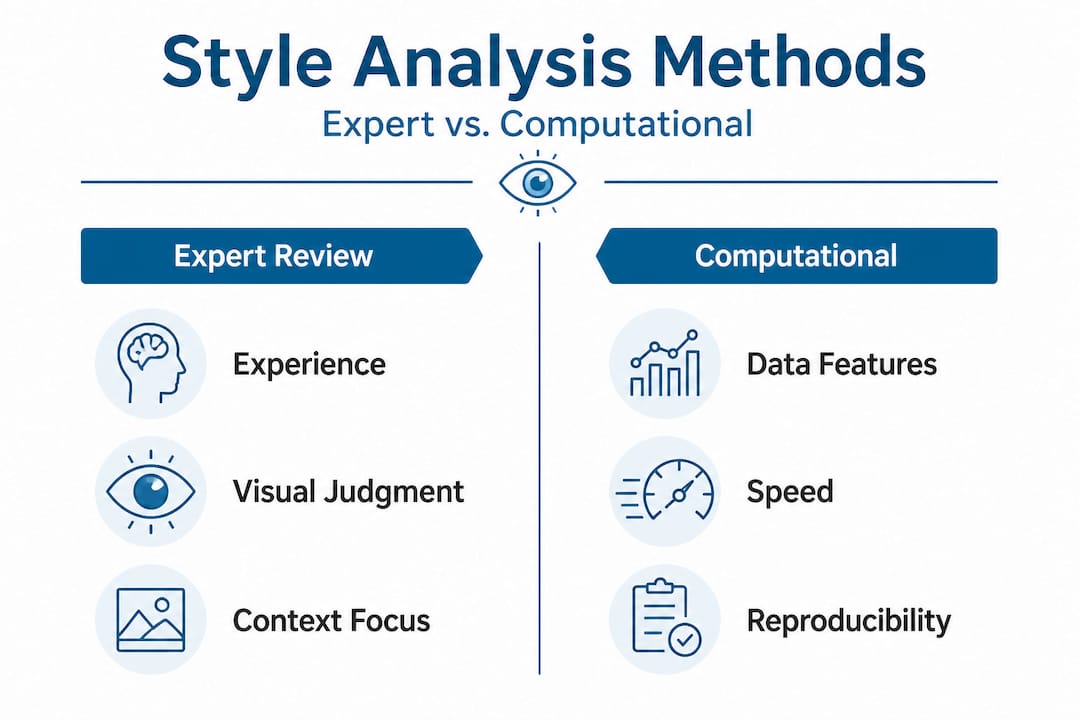
Here is a practical comparison of both approaches:
| Feature | Traditional expert analysis | Computational analysis |
|---|---|---|
| Speed | Slow (weeks to months) | Fast (minutes to hours) |
| Cost | High (specialist fees) | Scalable and lower per-work |
| Consistency | Variable across experts | Consistent and repeatable |
| Nuance and intent | Strong | Limited |
| Transparency | Depends on expert | Can include visual heatmaps |
| Historical context | Strong | Requires external integration |
| Scalability | Low | High |
For collectors building a portfolio, the smartest approach combines both methods. Use computational tools to flag inconsistencies quickly, then bring in expert review for high-value acquisitions or borderline cases.
How to apply this in practice:
- Start with a computational scan. Run the work through a style analysis platform to get an initial read on formal feature consistency.
- Review the output with context in mind. Look at where the tool flags anomalies and ask whether those anomalies have a historical explanation.
- Cross-reference against documented works. Compare the flagged features against authenticated pieces from the same period in the artist’s career.
- Engage an expert for high-stakes decisions. For acquisitions above your personal risk threshold, expert review remains essential.
- Document your reasoning. Record both the computational findings and the expert opinion so your due diligence is traceable.
Pro Tip: Never rely on a single method. A computational tool that flags no issues is not a green light on its own. Pair it with provenance research and, where possible, material analysis such as pigment testing or canvas dating.
The style authentication advances happening right now are making this combined approach more accessible than ever, even for collectors who are not working with major auction houses.
How style analysis supports authentication and investment decisions
With methods in mind, collectors should consider why style analysis matters, especially when authenticity and investment risk are on the line.
Authentication is rarely a binary yes or no. Modern research is explicit on this point: style used for authentication should be framed as probabilistic evidence of stylistic affinity rather than a single definitive label. Patch-based convolutional neural network methods can produce interpretable heatmap evidence tied to microtextural and brushwork cues, showing you exactly which regions of the canvas drove the analysis result.
This matters enormously for collectors. A heatmap that highlights the brushwork in the shadows of a figure’s face, and shows that this specific technique matches the artist’s authenticated works at a high confidence level, gives you something concrete to evaluate. It is not a black box verdict. It is traceable evidence you can discuss with an expert or present to a potential buyer.
“Definitive attribution still requires integration with historical, technical, and provenance analyses. Style analysis is one powerful layer, not the complete answer.”
Here is how style analysis contributes across different stages of an investment decision:
| Decision stage | Role of style analysis | Risk reduction |
|---|---|---|
| Initial screening | Flags stylistic inconsistencies early | Avoids wasted due diligence spend |
| Pre-purchase review | Provides formal feature comparison | Strengthens negotiating position |
| Valuation support | Documents stylistic quality and period alignment | Supports premium pricing |
| Resale preparation | Creates traceable authentication record | Increases buyer confidence |
| Dispute resolution | Offers objective visual evidence | Supports legal or insurance claims |
For investment-grade acquisitions, style analysis works best as one layer in a broader due diligence stack. Combine it with provenance documentation, material analysis, exhibition history, and expert opinion. Each layer either reinforces the attribution or surfaces a reason to pause.
Pro Tip: Ask any AI-assisted authentication for collectors platform you use whether it can produce region-specific evidence, not just an overall score. A tool that shows you where on the canvas it found stylistic alignment is far more useful than one that simply returns a percentage match.
Limitations, edge cases, and best practices
No method is perfect. Collectors must understand style analysis’ limits and use best practices to minimize costly mistakes.
The most significant limitation is the entanglement of style and subject matter. A model trained on an artist’s landscapes may perform poorly when asked to evaluate a portrait by the same artist, because the visual features of trees and faces differ so dramatically. Style can be entangled with subject matter and semantics, styles can overlap between workshop disciples and their masters, and models may struggle with stylistic subtleties or intent. This is not a minor caveat. It is a structural challenge that affects both human experts and computational tools.
Workshop attribution is a particularly thorny edge case. Many historical artists ran studios where assistants, apprentices, and collaborators produced works under the master’s supervision. These pieces often share strong stylistic similarities with the master’s authenticated works because the assistants were trained to replicate that style. Distinguishing a master’s hand from a skilled workshop assistant requires analysis at a very fine level of detail, often including brushwork micro-patterns, underdrawing analysis, and material composition.
Common pitfalls to watch for:
- Overconfidence in a single tool or expert. No single analysis method is definitive. Treat every result as evidence, not verdict.
- Ignoring period inconsistencies. An artist’s style evolves. A work attributed to an early period but showing late-period technical habits should raise questions.
- Neglecting provenance gaps. Strong stylistic alignment cannot compensate for a missing or suspicious ownership history.
- Assuming consistency across media. An artist’s style in oil may differ significantly from their work in watercolor or drawing. Cross-media comparisons require careful calibration.
- Failing to account for restoration. Heavily restored works can show altered surface characteristics that confuse both expert and computational analysis.
A practical collector workflow is to treat style analysis as three connected steps: first, formal and technical feature mapping; second, contextual cross-checking against the artist’s movement, period, influences, and documented statements; and third, a risk-managed conclusion that explicitly accounts for attribution uncertainty and possible workshop practice.
Pro Tip: Build attribution uncertainty into your pricing model. If you cannot fully resolve a stylistic question, factor that uncertainty into the price you are willing to pay. A work with a 70% stylistic match and incomplete provenance should not command the same price as a fully authenticated piece.
Navigating style analysis limitations is a skill that develops with experience, but having the right tools and a clear workflow significantly shortens the learning curve.
The real value and limits of style analysis for collectors
Having covered methods and edge cases, it is worth asking directly: what is the true value of style analysis, and where does its usefulness end?
We think the most honest answer is this: style analysis is a decision-support tool, not a decision-maker. It reduces uncertainty. It surfaces evidence. It gives you a structured basis for a conversation with an expert or a seller. But it does not replace judgment, and it should not be treated as a substitute for the full due diligence process.
What we find genuinely underappreciated in the collector community is the importance of interpretability. Style analysis is not purely classification: researchers stress interpretability and decision transparency, such as heatmaps and probability regions, as a bridge between computational evidence and expert judgment. When a tool shows you exactly which brushwork patterns drove its conclusion, you can evaluate that reasoning. When it hands you a score with no explanation, you are being asked to trust a black box. That is not good enough for investment-grade decisions.
We also believe that layering multiple checks is not just best practice, it is the only responsible approach for serious collectors. Each additional layer of evidence, whether formal analysis, provenance research, material testing, or expert review, either confirms the attribution or reveals a reason to look harder. The goal is not to achieve certainty, which is rarely possible in art attribution. The goal is to reduce risk to a level you can manage and justify.
The collectors who make the best long-term decisions are not the ones who trust their eye alone or defer entirely to a single expert. They are the ones who build a structured, transparent process and apply it consistently. Why transparent tools matter is not just a philosophical point. It is a practical advantage in a market where information asymmetry is the norm.
Take your art due diligence further
For collectors ready to apply a structured approach, the right tools can make all the difference.
ArtSleuth Studio puts AI-driven style analysis, authentication, and valuation tools directly in your hands. Whether you are screening a potential acquisition, building a verifiable record for your existing collection, or preparing a work for resale, the platform delivers the kind of structured, evidence-based insights this guide has outlined.

ArtSleuth’s style analysis features include brushwork and composition analysis, signature recognition, and tamper-proof digital certificates with QR codes and secure certificate IDs. Every report is designed to be transparent and traceable, giving you the interpretable evidence that serious collectors need. You get the formal feature mapping, the contextual cross-referencing, and the documentation, all in one place. Try ArtSleuth Analysis today and bring the same structured rigor to your next acquisition that this guide recommends.
Frequently asked questions
How is style analysis different from ordinary art appreciation?
Style analysis uses structured examination of visual features and contextual information, as artist style analysis is the structured evaluation of visual and technical characteristics plus context, while appreciation is a general and subjective response to a work.
Can style analysis confirm the authenticity of a painting on its own?
No. Style analysis provides probabilistic evidence of stylistic affinity, and definitive attribution still requires integration with historical, technical, and provenance analyses before any firm conclusion can be drawn.
What are the most common pitfalls in style analysis for collectors?
Confusing style with subject matter and overlooking workshop overlaps are major risks, because style can be entangled with subject matter and semantics, and styles can overlap significantly between a master and their workshop disciples.
Are AI tools better than expert connoisseurs for style analysis?
AI tools offer measurable consistency and speed, but models may struggle with stylistic subtleties or intent, which highlights the continuing importance of human expertise for nuanced attribution decisions.
No comments yet. Be the first to share your thoughts!