The ArtSleuth Chronicle
“Curated insights from the world of art.”
Today's Edition
November 2, 2026On This Day
-
1699
Born
Jean-Baptiste-Siméon Chardin was born; the French painter became recognized as a master of still life and domestic scenes marked by soft light and granular impasto.
Wikipedia → -
1933
Died
Chinese painter Gao Qifeng died; he co-founded the Lingnan School after studying Western and Japanese art techniques in Tokyo.
Wikipedia → -
1939
Born
Richard Serra was born; the postminimalist sculptor became renowned for his large-scale, site-specific abstract works that emphasized industrial materials.
Wikipedia → -
1992
Died
American sculptor Robert Arneson died; he was a professor of ceramics at UC Davis who made lasting contributions to American sculpture.
Wikipedia →
Artwork of the Day
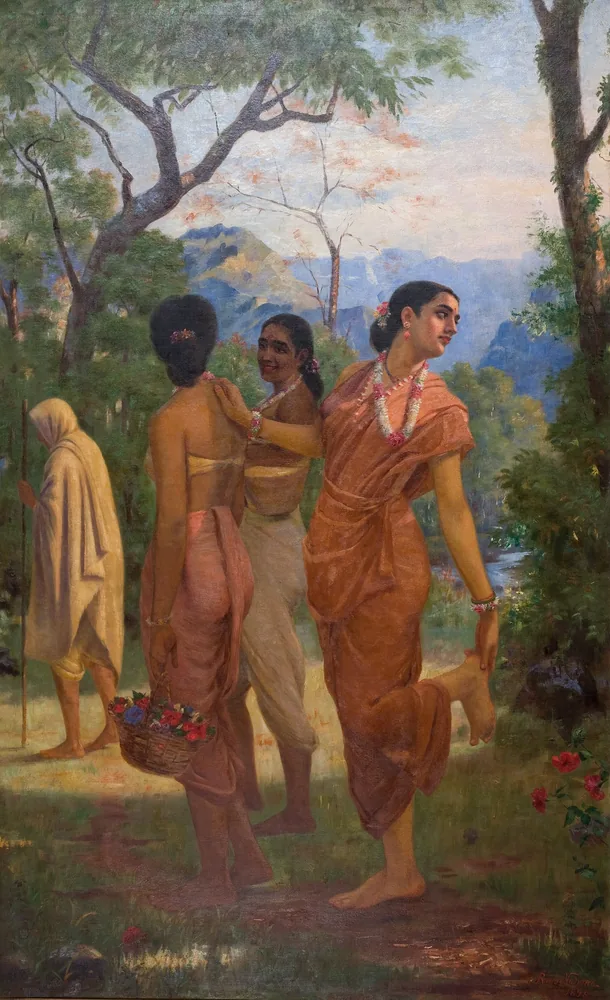
Shakuntala
In his 1898 epic painting Shakuntala, Indian artist Raja Ravi Varma brings to life a celebrated character from the epic Mahabharata. The composition depicts Shakuntala feigning to remove a thorn from her foot, using the pretext to glance back and catch sight of her husband and lover, Dushyanta, while her companions playfully tease her and call her bluff. Varma executed the scene as a frozen tableau, capturing a single suspended moment that functions much like a still from a moving picture plucked from a broader narrative. Art historian Tapati Guha-Thakurta observed that Shakuntala's distinctive posture—the dynamic twist and turn of her head and body—immediately pulls the viewer directly into the storyline, prompting the imagination to reconstruct the unfolding sequence of events. Furthermore, the artwork highlights how the unseen male lover serves as the central point of reference, demonstrating the powerful role of the male gaze in defining the feminine image within historical Indian painting.
Look for
- Shakuntala's twisted posture as she pretends to remove a thorn from her foot
- The teasing friends calling her bluff
- The absent figure of Dushyanta, who remains the focal point of her backward glance
The Daily Quiz
5 questions from today's reading. Pick an answer to see if you're right.
-
Which group of artists initially led the state-funded Mexican muralist project during the 1920s?
Answer
The Big Three. The project was headed by Diego Rivera, José Clemente Orozco, and David Alfaro Siqueiros, collectively known as 'The Big Three' or 'The Three Greats.'
-
What unusual material does El Anatsui transform into shimmering wall sculptures?
Answer
Aluminum pieces from alcohol recycling stations sewn with copper wire. El Anatsui creates his metallic wall sculptures from thousands of aluminum pieces sourced from alcohol recycling stations joined by copper wire.
-
What is the defining visual characteristic of the impasto technique?
Answer
Paint applied thickly enough that brush or knife marks remain visible. Impasto involves laying paint on so thickly that visible brush or knife marks create texture that seems to project from the canvas.
-
Which celebrated artwork hangs in the permanent collection of the Art Institute of Chicago?
Answer
Nighthawks by Edward Hopper. Edward Hopper's famous painting Nighthawks is preserved among the nearly 300,000 works in the Art Institute of Chicago's collection.
-
Which modern art movement is René Magritte primarily associated with?
Answer
Surrealism. René Magritte was a prominent Belgian surrealist known for depicting ordinary objects in unexpected settings.
Puzzle Corner
Who am I?
- Along with Pablo Picasso, I am regarded as one of the artists who best helped define the revolutionary visual art developments of the early twentieth century.
- In the decade after 1906, I developed a rigorous style characterized by flattened forms and decorative pattern.
- Although I produced noted work in sculpture, printmaking, and drawing, I achieved my greatest renown as a painter.
- Between 1900 and 1905, the intense color of my paintings led critics to brand me a leader of the Fauves, or 'wild beasts'.
Reveal the answer
Henri Matisse. I am Henri Matisse, the French master celebrated for defining modern art through bold color and expressive form. Wikipedia →
Scrambled masters
RTRBDNMEA
Dutch Golden Age master celebrated for hundreds of etchings, self-portraits, and biblical scenes.
Show answer
Rembrandt Wikipedia →
DEGAR ADEGS
French Impressionist and realist draftsman famed for his oil paintings and pastels of ballet dancers.
Show answer
Edgar Degas Wikipedia →
OYAYI KUAAMS
Japanese contemporary artist known for conceptual works, installations, and top-selling market success.
Show answer
Yayoi Kusama Wikipedia →
Word of the Day
Still life
STIL-lyfe
A genre of visual art depicting inanimate objects, whether natural items such as food and flowers or human-made goods like glassware and books. It allows artists exceptional freedom in arranging compositional elements.
Example: Jean-Baptiste-Siméon Chardin's quiet kitchen and tabletop arrangements.
Wikipedia →Daily features are written by ArtSleuth's AI (Google Gemini) from the linked Wikipedia articles. Paintings: public domain, via Wikimedia Commons.