The ArtSleuth Chronicle
“Curated insights from the world of art.”
Today's Edition
September 29, 2026On This Day
-
1703
Born
Rococo master François Boucher was born; he became celebrated across eighteenth-century France for his idyllic classical scenes, pastoral views, and decorative allegories.
Wikipedia → -
1910
Died
American master Winslow Homer died; he is renowned for his powerful marine oil paintings and fluid, prolific watercolors chronicling working vacations.
Wikipedia → -
1930
Died
Ukrainian-born Russian realist Ilya Repin died; he was famed for monumental masterworks such as Barge Haulers on the Volga and insightful portraits of figures like Leo Tolstoy.
Wikipedia → -
1997
Died
Pop Art pioneer Roy Lichtenstein died; he achieved international acclaim by transforming comic book panels and advertising prints using hand-painted Ben-Day dots.
Wikipedia →
Artwork of the Day
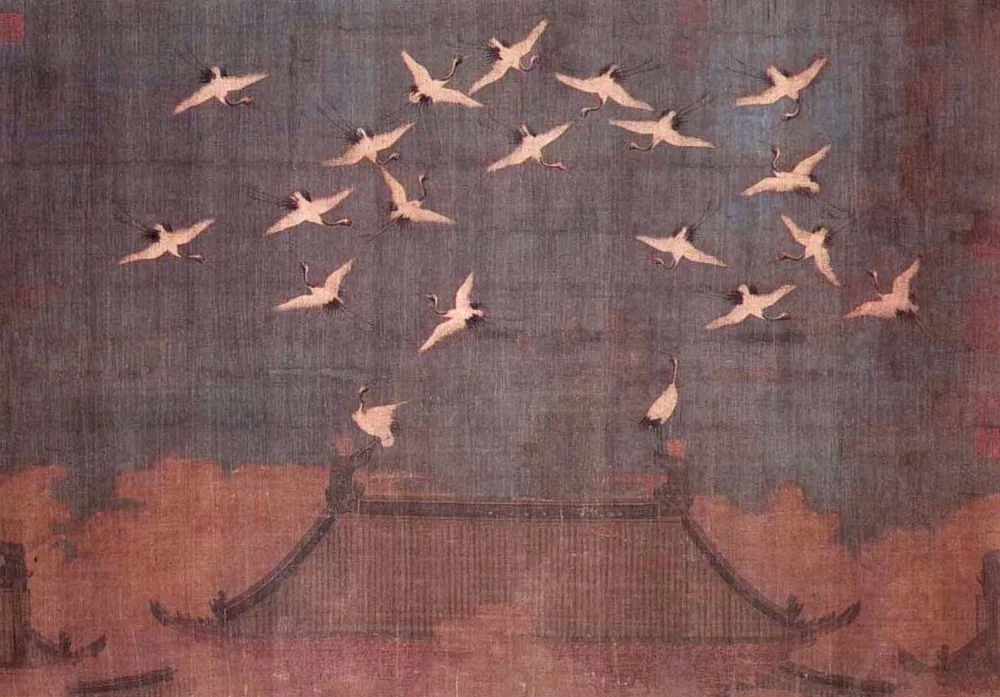
Auspicious Cranes
Auspicious Cranes, painted in 1112 by Emperor Huizong of Song, records an event interpreted as a divine sign of heavenly favor. Huizong, the eighth emperor of China's Song dynasty and a devoted patron who promoted Taoism, pursued a luxurious court life alongside ambitious architectural projects. The composition illustrates a flock of white cranes swirling and gliding above an ornate imperial roof shrouded in swirling mist. Cranes were traditional Taoist symbols of immortality and auspicious blessings. Huizong created the work combining fine painting and refined calligraphy to commemorate the sighting as proof of cosmological approval for his reign. Although peasant rebellions and political unrest troubled his realm before his eventual abdication in 1126, this delicate handscroll remains one of the most celebrated masterworks associated with his imperial court, capturing an ethereal moment where heavenly omens met refined imperial authority.
Look for
- White cranes soaring gracefully across the sky above the palace roof
- Two cranes perched atop the ornamental roof ridge of the gate
- Soft clouds and mists hovering around the tiled imperial architecture
The Daily Quiz
5 questions from today's reading. Pick an answer to see if you're right.
-
Which trio of painters was known as 'The Big Three' of the Mexican muralism movement?
Answer
Diego Rivera, José Clemente Orozco, and David Alfaro Siqueiros. The muralist project beginning in the 1920s was led by 'The Big Three': Diego Rivera, José Clemente Orozco, and David Alfaro Siqueiros.
-
From his thirties onwards, where was Michelangelo primarily active?
Answer
Rome. Although born in the Republic of Florence, Michelangelo was mostly active in Rome from his thirties onwards.
-
What is the intentional crackle pattern characteristic of in Chinese ceramics?
Answer
Ge ware. In ceramics, craquelure in glazes is known as 'crackle' and is a particular characteristic of Chinese Ge ware.
-
At what age did Wassily Kandinsky begin his formal studies in painting?
Answer
30. Kandinsky began his studies in life-drawing, sketching, and anatomy at the age of 30.
-
The founding collection of the Hermitage Museum was acquired by Catherine the Great from which merchant?
Answer
Johann Ernst Gotzkowsky. The Hermitage was established in 1764 when Catherine the Great purchased a collection of paintings from Berlin merchant Johann Ernst Gotzkowsky.
Puzzle Corner
Who am I?
- Born in Swedish Pomerania on the Baltic coast, I later studied in Copenhagen before settling in Dresden.
- My subjective, anti-classical landscapes often direct the viewer's gaze toward a metaphysical dimension.
- I frequently placed diminished, contemplative figures silhouetted against morning mists, Gothic ruins, or evening skies.
- I am considered the defining landscape painter of German Romanticism, famous for Wanderer above the Sea of Fog.
Reveal the answer
Caspar David Friedrich. Caspar David Friedrich was the quintessential German Romantic painter whose contemplative landscapes explored profound human emotion and nature. Wikipedia →
Scrambled masters
GOIED QZVLUAEZE
Court painter to King Philip IV of Spain and creator of Las Meninas.
Show answer
Diego Velázquez Wikipedia →
SNODAR TEBLILTCIO
Early Renaissance master who painted Primavera and The Birth of Venus.
Show answer
Sandro Botticelli Wikipedia →
OGNE EECIHLS
Austrian Expressionist protégé of Gustav Klimt known for raw, twisted nude self-portraits.
Show answer
Egon Schiele Wikipedia →
Word of the Day
Encaustic painting
en-KAW-stik PAYN-ting
A method of painting using heated beeswax combined with colored pigments and resin, applied to wood or canvas and shaped with heated metal tools.
Example: The Fayum mummy portraits from Roman Egypt.
Wikipedia →Daily features are written by ArtSleuth's AI (Google Gemini) from the linked Wikipedia articles. Paintings: public domain, via Wikimedia Commons.