The ArtSleuth Chronicle
“Curated insights from the world of art.”
Edition of September 27, 2026
On This Day
-
1911
Born
American photographer Marcey Jacobson, celebrated for her photographs documenting indigenous peoples in Southern Mexico, was born.
Wikipedia → -
1917
Died
French Impressionist Edgar Degas, famed for his masterly drawings, oil paintings, and wax sculptures of dancers and bathers, died.
Wikipedia → -
1946
Born
Native American painter and sculptor T. C. Cannon, an enrolled member of the Kiowa Indian Tribe of Oklahoma, was born.
Wikipedia → -
2011
Died
Hungarian architect Imre Makovecz, a leading proponent of organic architecture and founder of the Hungarian Academy of Arts, died.
Wikipedia →
Artwork of the Day
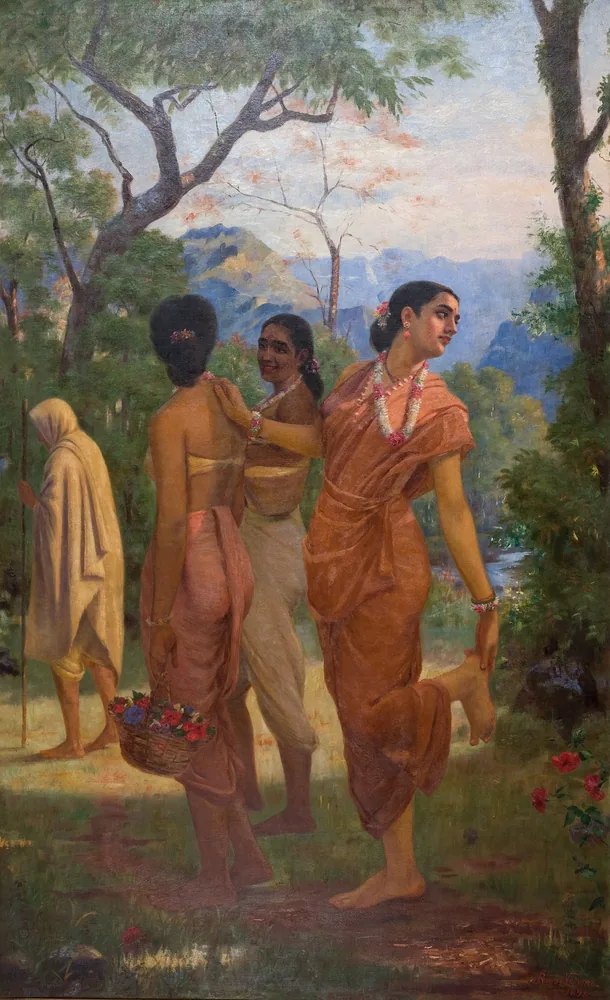
Shakuntala
Painted in 1898 by Indian artist Raja Ravi Varma, Shakuntala (also titled Shakuntala looking for Dushyanta) captures a poignant moment from the ancient epic Mahabharata. The composition depicts the heroine Shakuntala pretending to pause and remove a thorn from her foot, while slyly turning back to catch sight of her lover, Dushyanta. Beside her, companions notice her clever pretext, playfully calling her bluff. Art historian Tapati Guha-Thakurta observed that this deliberate twist and turn of Shakuntala's body draws viewers directly into the ongoing narrative, creating a frozen tableau resembling a cinematic still. Though Dushyanta remains unseen outside the pictorial frame, his presence defines the scene, highlighting how the male gaze shapes the feminine portrayal. Ravi Varma's work stands as a celebrated landmark in Indian art history, transforming traditional literary spectacle into an evocative, dramatic moment.
Look for
- The heroine twisting her head and torso to glance back
- Her hand reaching down to pretend to extract a thorn
- Her teasing companions reacting to her clever excuse
The Daily Quiz
5 questions from today's reading. Pick an answer to see if you're right.
-
Which artistic movement's dramatic style influenced Peter Paul Rubens's emphasis on movement and sensuality?
Answer
The Counter-Reformation. Rubens followed the immediate, dramatic style promoted in the Counter-Reformation.
-
Which architects designed the buildings of the Van Gogh Museum in Amsterdam?
Answer
Gerrit Rietveld and Kisho Kurokawa. The museum's buildings were designed by Gerrit Rietveld and Kisho Kurokawa.
-
Which painter was the original proponent of the French Realism movement in the 1840s?
Answer
Gustave Courbet. Gustave Courbet was the original proponent of Realism, portraying real and typical contemporary people.
-
What is the extreme form of chiaroscuro called when shadow and contrast strongly focus on the subject?
Answer
Tenebrism. When taken to its extreme to focus strongly on the subject of a painting, the technique is called tenebrism.
-
Alongside Giorgione, Titian is celebrated as a founder of which regional art tradition?
Answer
Venetian Renaissance painting. Titian was the most important artist of Venetian Renaissance painting and is considered a founder of the school alongside Giorgione.
Puzzle Corner
Who am I?
- A crater on the planet Mercury carries my surname in recognition of my artistic legacy.
- Celebrated by international media as Africa's Greatest Artist, my fame helped bolster Black Nationalist movements worldwide.
- As a pioneering painter and sculptor awarded an MBE, I opened doors for modern African art in august Western spaces.
- Born in 1917, I came from Nigeria to be hailed as arguably the most influential African artist of the 20th century.
Reveal the answer
Ben Enwonwu. You are Ben Enwonwu, the celebrated Nigerian modernist painter and sculptor. Wikipedia →
Scrambled masters
LTRCAEBH REDUR
Nuremberg master who revolutionized woodcuts and expanded the tonal range of engravings.
Show answer
Albrecht Dürer Wikipedia →
ULAP EZCNNAE
French Post-Impressionist whose structural compositions formed a bridge to early Cubism.
Show answer
Paul Cézanne Wikipedia →
IYLSSWA ANINKDYSK
Russian pioneer of Western abstraction who co-founded the Museum of the Culture of Painting.
Show answer
Wassily Kandinsky Wikipedia →
Word of the Day
Perspective
per-SPEK-tiv
The approximate representation on a flat surface of a three-dimensional scene as it appears to the eye, making objects appear smaller as their distance increases.
Example: Linear perspective
Wikipedia →Daily features are written by ArtSleuth's AI (Google Gemini) from the linked Wikipedia articles. Paintings: public domain, via Wikimedia Commons.