The ArtSleuth Chronicle
“Curated insights from the world of art.”
Edition of September 25, 2026
On This Day
-
1599
Born
Francesco Borromini was an inventive Swiss-Italian Baroque architect who designed the churches of San Carlo alle Quattro Fontane and Sant'Agnese in Agone.
Wikipedia → -
1903
Born
Mark Rothko was an influential abstract painter renowned for his luminous color field canvases featuring rectangular regions of color.
Wikipedia → -
1928
Died
Richard F. Outcault was an American cartoonist who created The Yellow Kid and Buster Brown, pioneering the modern comic strip.
Wikipedia → -
2007
Died
André Emmerich was an influential German-American art dealer and gallerist specializing in color field painting and pre-Columbian art.
Wikipedia →
Artwork of the Day
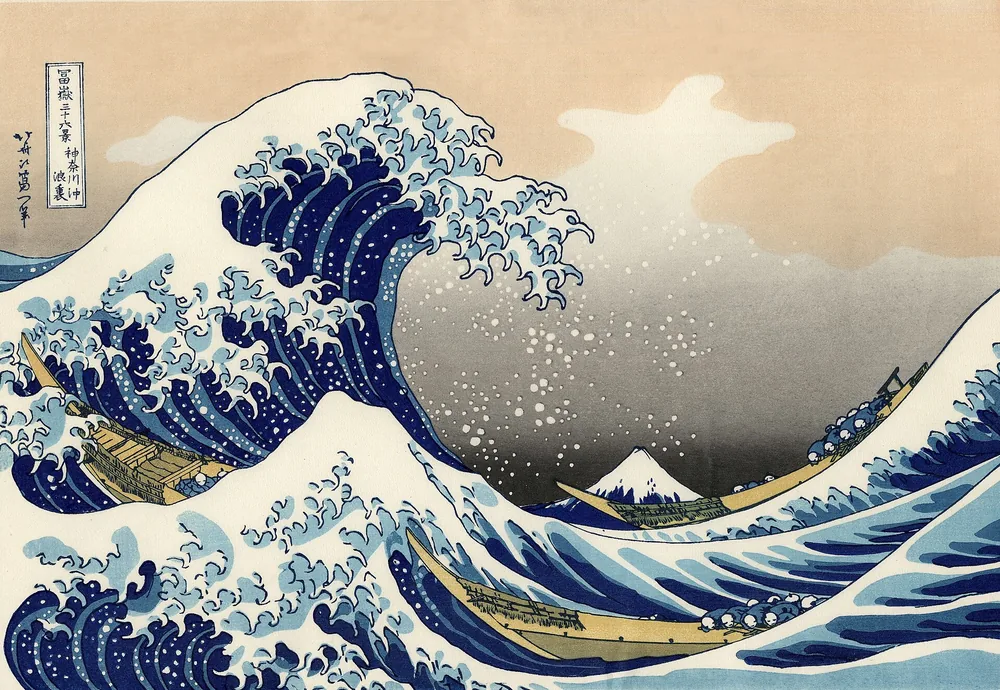
The Great Wave off Kanagawa
Created in late 1831 during Japan's Edo period, The Great Wave off Kanagawa is a seminal woodblock print by ukiyo-e master Katsushika Hokusai. It depicts three boats plunging through a turbulent sea beneath a towering, cresting spiral of water, framed against a distant Mount Fuji. Serving as the opening design of Hokusai's celebrated series Thirty-six Views of Mount Fuji, the print transformed Japanese printmaking through its innovative deployment of imported Prussian blue. The dynamic composition synthesizes classical Japanese print traditions with principles of European graphical perspective. This brilliant fusion brought Hokusai immediate acclaim across Japan and subsequently captivated the Western art world, providing profound inspiration for European Impressionist painters.
Look for
- The towering crest of the central wave forming a dramatic spiral over the sea
- Three slender boats maneuvering beneath the crashing waves
- The snowy summit of Mount Fuji framed quietly in the background
The Daily Quiz
5 questions from today's reading. Pick an answer to see if you're right.
-
What English term was later used for De Stijl's underlying artistic theory, originally named Nieuwe Beelding?
Answer
Neoplasticism. The artistic theory underpinning De Stijl, known in Dutch as Nieuwe Beelding, was translated into English as Neoplasticism.
-
Jean-Michel Basquiat first gained notoriety in the late 1970s as part of which Manhattan graffiti duo?
Answer
SAMO. Basquiat gained early recognition alongside Al Diaz by writing cryptic epigrams across Manhattan under the moniker SAMO.
-
At what age was J. M. W. Turner admitted as a student to the Royal Academy of Arts?
Answer
14. A recognized child prodigy, Turner entered the Royal Academy of Arts as a student at age 14.
-
Which artists developed the Pointillist painting technique in 1886?
Answer
Georges Seurat and Paul Signac. Georges Seurat and Paul Signac formulated the dot-based technique of Pointillism in 1886 as an offshoot of Impressionism.
-
Under which agreement was the Medici art collection bequeathed to the city of Florence?
Answer
Patto di famiglia. The Medici art holdings were granted to Florence under the Patto di famiglia, negotiated by heiress Anna Maria Luisa.
Puzzle Corner
Who am I?
- I was the very first woman admitted to Florence's Accademia di Arte del Disegno.
- Initially working in the dramatic style of Caravaggio, I was producing professional art by the age of 15.
- I worked abroad in London at the court of King Charles I between 1638 and 1642 before departing during the early English Civil War.
- After disappearing from records for several turbulent years, I resurfaced in Naples in 1649 to continue my successful painting career.
Reveal the answer
Artemisia Gentileschi. You are Italian Baroque painter Artemisia Gentileschi. Wikipedia →
Scrambled masters
PALOB POSCAIS
Spanish pioneer of Cubism and collage who created Guernica and Les Demoiselles d'Avignon.
Show answer
Pablo Picasso Wikipedia →
NENHSJOA EERERVM
Dutch Golden Age master from Delft known for quiet domestic interior scenes painted with costly pigments.
Show answer
Johannes Vermeer Wikipedia →
OHJN ALBONETSC
English Romantic landscape painter celebrated for Dedham Vale views and The Hay Wain.
Show answer
John Constable Wikipedia →
Word of the Day
Encaustic painting
en-KAW-stik PAYN-ting
A painting method where molten beeswax, damar resin, and pigments are applied warm and shaped with metal tools.
Example: Fayum mummy portraits from Roman Egypt.
Wikipedia →Daily features are written by ArtSleuth's AI (Google Gemini) from the linked Wikipedia articles. Paintings: public domain, via Wikimedia Commons.