The ArtSleuth Chronicle
“Curated insights from the world of art.”
Edition of September 23, 2026
On This Day
-
1865
Born
French painter Suzanne Valadon was born; she became the first woman painter admitted to the Société Nationale des Beaux-Arts.
Wikipedia → -
1897
Born
Belgian painter Paul Delvaux was born, later celebrated for his dream-like scenes juxtaposing classical architecture, trains, and skeletons.
Wikipedia → -
1899
Born
American sculptor Louise Nevelson was born, renowned for her monumental, monochromatic wooden wall pieces and outdoor sculptures.
Wikipedia → -
1913
Born
Danish painter and sculptor Carl-Henning Pedersen was born, rising to prominence as a key figure of the COBRA art movement.
Wikipedia →
Artwork of the Day
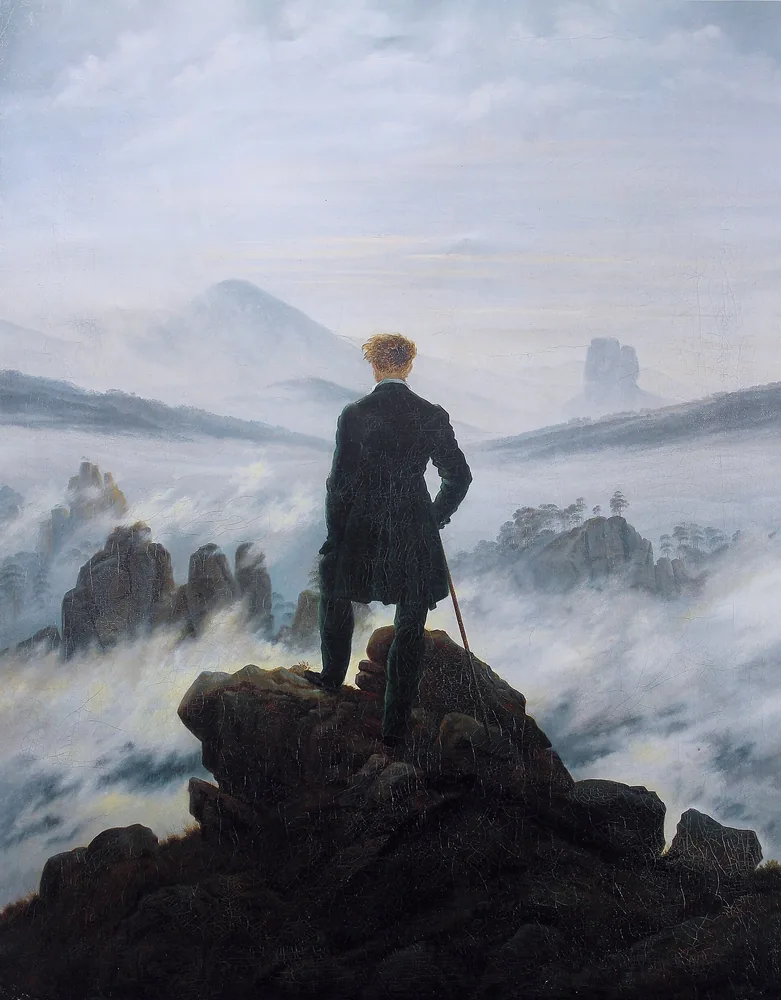
Wanderer above the Sea of Fog
Painted around 1818 by German Romanticist artist Caspar David Friedrich, Wanderer above the Sea of Fog stands as a defining masterpiece of the Romantic era. The composition portrays a lone man standing upon a dark, rocky precipice with his back turned directly toward the viewer, surveying a vast expanse of swirling fog that stretches endlessly into the distance. Through the dense mist, rugged ridges, isolated trees, and distant mountain peaks dramatically pierce the surface. Friedrich frequently used the Rückenfigur, or rear-facing figure, to pull observers into the subject's private encounter with nature. Rather than offering a standard topographical view, the painting evokes the sublime and serves as an emblem of profound self-reflection, contemplating life's uncertain path. It remains Friedrich's most celebrated Rückenfigur and a powerful embodiment of the Romantic spirit.
Look for
- The solitary rear-facing figure poised on the dark, rugged precipice.
- The thick sea of fog unfurling into the distant horizon.
- Rugged mountain ridges and trees piercing through the mist.
The Daily Quiz
5 questions from today's reading. Pick an answer to see if you're right.
-
Who designed the current main building of the Rijksmuseum that opened in 1885?
Answer
Pierre Cuypers. The current main building of the Rijksmuseum was designed by architect Pierre Cuypers.
-
What was the name of the spiritual circle of women to which Hilma af Klint belonged?
Answer
The Five. Hilma af Klint belonged to a circle of women inspired by Theosophy known as 'The Five'.
-
What is the primary artistic goal of Expressionism?
Answer
To express emotional experience rather than physical reality. Expressionist artists sought to express subjective emotional experience rather than objective physical reality.
-
In linear perspective, what occurs to an object during foreshortening?
Answer
Its dimensions parallel to the line of sight appear shorter. Foreshortening causes an object's dimensions parallel to the line of sight to appear shorter than those perpendicular to it.
-
Which artistic label did Edgar Degas reject, preferring instead to be called a realist?
Answer
Impressionist. Although regarded as a founder of Impressionism, Degas rejected the term and preferred to be called a realist.
Puzzle Corner
Who am I?
- I studied painting in Paris under Maurice Denis and André Lhote after leaving Saint Petersburg.
- My visual style blended refined late cubism with the neoclassical elegance of Jean-Dominique Ingres.
- I became celebrated for my polished, glamorous portraits of aristocrats and the wealthy during the Art Deco era.
- Born in Warsaw, I spent my long artistic career working between France and the United States.
Reveal the answer
Tamara de Lempicka. You are Tamara de Lempicka, the iconic Art Deco painter known for your stylized portraits and nudes. Wikipedia →
Scrambled masters
NNDREOFA ROETBO
Colombian painter and sculptor famous for depicting figures and objects in large, exaggerated volume.
Show answer
Fernando Botero Wikipedia →
IKUHOAS
Japanese ukiyo-e printmaker of the Edo period who created the iconic Thirty-Six Views of Mount Fuji series.
Show answer
Hokusai Wikipedia →
CBEARTLH EURDR
Nuremberg master of the German Renaissance celebrated across Europe for his revolutionary woodcuts and engravings.
Show answer
Albrecht Dürer Wikipedia →
Word of the Day
Grisaille
griz-EYE
A painting executed entirely in shades of black, grey, or neutral greyish tones. It is often employed in large decorative schemes to imitate relief sculpture, or as an underpainting for glazes.
Example: Peter Paul Rubens and his workshop frequently used monochrome sketches in grisaille as models for engravers.
Wikipedia →Daily features are written by ArtSleuth's AI (Google Gemini) from the linked Wikipedia articles. Paintings: public domain, via Wikimedia Commons.